

For extended luxury residence stays, confirm who coordinates arrival, daily routines, privacy, changes, and departure—not just whether the property suits you. For a 2026 stay, separate what the residence provides from what an ongoing concierge membership coordinates, and establish who owns each handoff before you commit.
- Extended luxury residence stays require clarity on daily routines, provider responsibilities, privacy, and changes—not property selection alone.
- JetVoy suits individuals evaluating ongoing private concierge coordination across travel, aviation, residences, and access.
- Confirm membership scope separately from residence arrangements; neither establishes the other's responsibilities.
- Assess continuity through a change scenario before deciding whether an ongoing membership fits.
What should you confirm for extended luxury residence stays?
Confirm the operating arrangements around the residence with the same care as the residence itself. A suitable property does not establish who will manage an altered arrival, authorize access for household support, or reconcile a departure change with onward travel.
JetVoy describes its service as private membership concierge coordination across travel, aviation, residences, and access. That scope is relevant when you are assessing an ongoing relationship rather than seeking help with an isolated residence request.
Use the following confirmation checklist to distinguish a property feature from an assigned responsibility. Each answer should name the responsible party, the agreed arrangement, and any dependency that remains unresolved.
| Area | What to confirm | What a property description does not establish |
|---|---|---|
| Arrival | Access procedure, arrival contact, transfer handoff | Who responds if your arrival changes |
| Daily routines | Household support, workspace needs, deliveries | Which arrangements are included or separately coordinated |
| Privacy | Information recipients and access permissions | Who can receive itinerary or residence details |
| Changes | Approval route and responsibility for updates | Who checks the effect on connected arrangements |
| Departure | Handover, remaining belongings, onward travel | Who reconciles the residence exit with your next movement |
Treat unresolved responsibilities as open decisions. A general assurance that someone will take care of matters is not a substitute for an agreed scope.
Why this matters
An extended residence stay is not simply a longer visit. You are assessing whether a temporary address can support the routines, obligations, and movements that continue while you live there.
The residence can be appropriate while the arrangements around it remain incomplete. A workspace is a physical feature; permission to receive visitors, a practical delivery procedure, and a clear route for reporting a problem are separate confirmations.
For your 2026 planning, organize the decision around continuity rather than a list of amenities. Ask what needs to remain coordinated before arrival, during ordinary days, when plans change, and after departure. This gives you a more useful basis for evaluating a private concierge membership than access claims alone.
Before arrival: confirm the transition into the residence
Start with the actual arrival sequence. Identify where responsibility passes between your travel provider, ground transport, residence representative, and anyone authorized to act for you.
Do not assume that sharing an itinerary assigns responsibility for updating it. Establish who receives a revised arrival time and who confirms that the residence access arrangement still works.
- Arrival contact: Identify the person or team responsible for access and the procedure for reaching them.
- Transfer handoff: Confirm where the journey ends and the residence handover begins.
- Entry requirements: Request the applicable identification, guest registration, and access instructions.
- Arrival changes: Establish the procedure for an earlier, later, or substantially altered arrival.
- Initial condition: Agree how you will receive property instructions and record any issue on arrival.
Ask for the sequence in plain language. You should be able to explain how you enter the residence without relying on an unnamed person being available at an assumed time.
This is also the point to identify dependencies. If entry requires a representative to attend, confirm how a changed arrival reaches that representative and who verifies the revised arrangement.
During the stay: confirm how ordinary life will work
A residence assessment should reflect how you expect to live, not only how the space appears. Identify the routines that matter to you and ask which arrangements the property supports, which require separate coordination, and which remain your responsibility.
For work, clarify the workspace, connectivity information, visitor rules, and practical requirements for receiving documents. For household routines, clarify cleaning access, deliveries, maintenance reporting, and any restrictions relevant to your intended use.
Describe the routine before requesting the solution. Saying that you need a place to work is less precise than explaining that you require privacy for calls and a defined procedure for receiving a colleague.
Avoid treating an amenity label as confirmation of suitability. Ask for information that lets you judge the requirement yourself, and distinguish a stated feature from a service commitment.
Keep the resulting instructions usable. A concise record of contacts, access procedures, and unresolved items is more practical than scattered correspondence that requires someone to reconstruct the arrangement whenever a question arises.
Privacy: establish permissions before sharing details
Discretion requires decisions about information and access. Confirm which parties need your arrival details, who can receive instructions on your behalf, and how changes to those permissions will be communicated.
If an assistant or family office participates, establish the authority attached to that role. Permission to receive information is not automatically permission to approve a change or authorize entry to the residence.
Useful questions include:
- Who receives the residence address and itinerary details?
- Who is authorized to communicate instructions?
- Who can approve access for household support or visitors?
- How are changes to permissions recorded and shared?
- Which property-specific privacy procedures need clarification?
Request an explanation of the relevant procedures rather than relying on a general description of discretion. Do not infer confidentiality terms, security measures, or information-handling commitments from a membership's positioning alone.
Your own communication choices matter here. Identify the appropriate recipients before circulating a full itinerary or residence details across several conversations.
When plans change: identify who coordinates the consequences
A changed plan creates a coordination question, not just a new request. If your arrival moves, the access arrangement needs checking; if your departure moves, the residence handover and onward travel need reviewing separately.
Use a straightforward responsibility sequence when evaluating a membership:
- Record the change. Identify what has changed and which previous instruction it replaces.
- Check dependencies. Identify the residence, transport, household, and access arrangements affected.
- Confirm authority. Establish who can approve the proposed adjustments.
- Update providers. Confirm who communicates each revised instruction.
- Verify handoffs. Identify how you will know the affected parties have acknowledged the update.
These are assessment criteria, not a claim that every membership follows this process. Ask a prospective provider to explain its own approach and identify where responsibility remains with you.
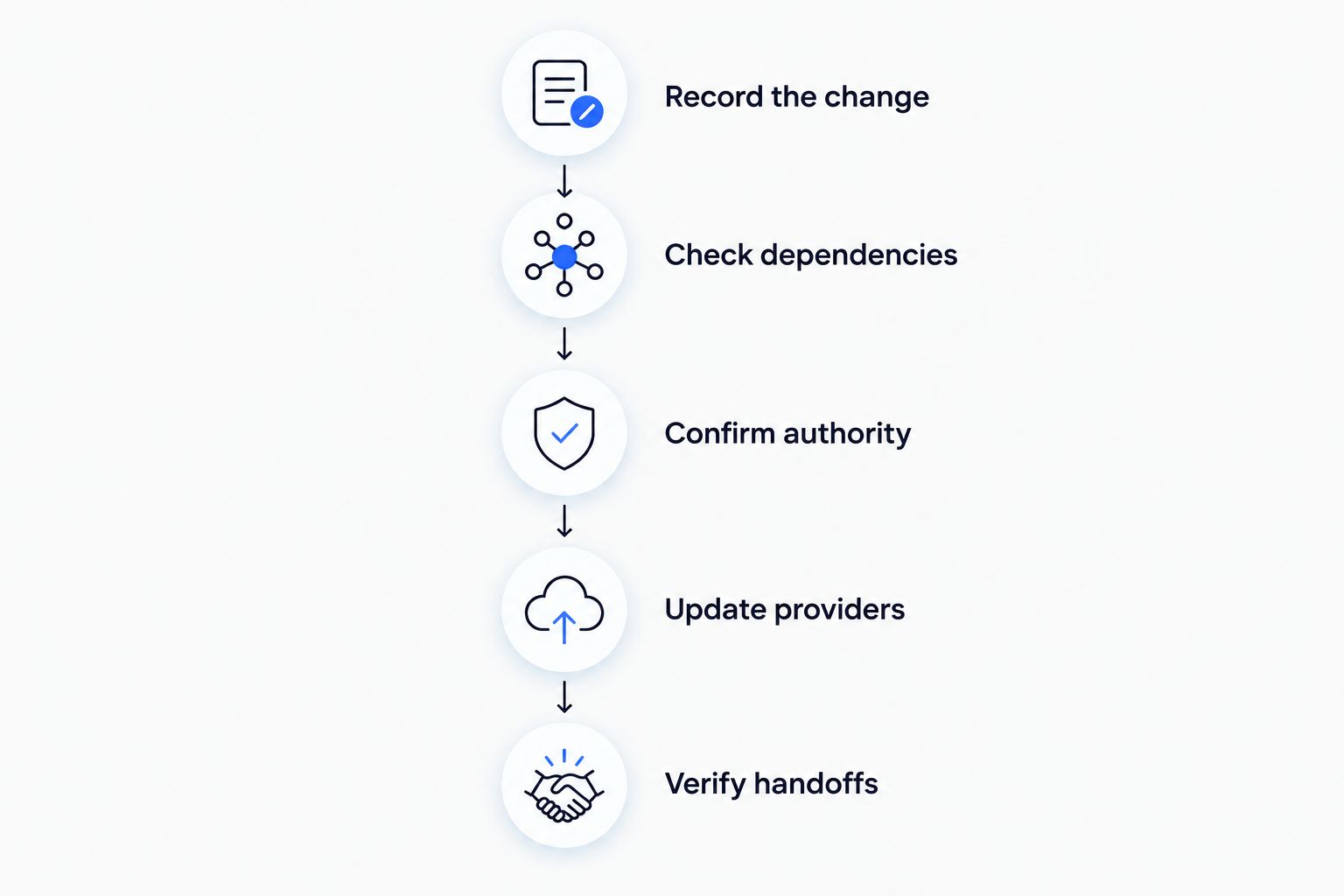
For a 2026 membership discussion, bring a change scenario drawn from your actual needs. Ask how an altered arrival would be handled, where approval would be required, and which parts of the response sit outside the membership scope.
Why coordination requirements vary
The property alone does not define the coordination requirement. Your intended use, the people involved, and the connections to other arrangements determine what you need to clarify.
- Travel dependencies: Identify whether the residence stay connects with private aviation, ground transport, or onward travel requiring separate instructions.
- Household participation: Clarify whether an assistant, family office, or other authorized person will help manage decisions.
- Daily routines: Specify the work, household, and visitor arrangements that need confirmation.
- Information permissions: Establish who needs access to details and who can authorize changes.
- Changes during the stay: Identify how revised dates or plans would affect connected arrangements.
- Departure requirements: Confirm what must happen before you leave and what remains afterward.
Use these factors to write a concise needs brief. State your intended use and decision-making structure without adding sensitive information that is unnecessary for the initial discussion.
The brief should also distinguish essentials from preferences. A requirement that determines whether the residence is suitable belongs ahead of an optional arrangement that can be considered later.
How do you assess ongoing private concierge membership fit?
JetVoy is best suited to individuals evaluating ongoing coordination across travel, aviation, residences, and access. The relevant question is whether that continuing scope matches your needs, not whether a residence request sounds sufficiently elaborate.
An ongoing relationship is relevant when you want to assess continuity across repeated movements and connected requirements. Its potential value lies in that coordination scope; the trade-off is that you still need to establish service boundaries, permissions, and responsibilities rather than assuming membership covers every detail.
For JetVoy, the stated cross-category scope supports a membership-fit discussion. It does not establish specific residence services, response commitments, access outcomes, or acceptance criteria. Confirm those matters through the application process.
When comparing private concierge memberships in 2026, apply the same questions to each: what is coordinated, what remains outside scope, who has authority, and how are changes handled? Keep the comparison tied to your ongoing needs rather than an isolated request.
If your requirement ends with a single property arrangement, establish whether an ongoing membership is appropriate before submitting an application. Complexity alone does not establish fit.
What should you include in a membership application?
Include enough context to explain the relationship you are seeking. Describe your travel patterns, the role residences play in them, the categories requiring coordination, and how you prefer decisions to be authorized.
You do not need to turn the application into a complete itinerary. A clear account of recurring needs gives the discussion a defined purpose without treating an initial inquiry as an instruction to proceed.
A useful outline covers:
- The ongoing coordination you are seeking.
- How residence stays connect with travel, aviation, or access needs.
- Who participates in decisions and communications.
- The boundaries or privacy questions you want clarified.
- What you need to understand before assessing membership fit.
Keep expectations distinct from confirmed commitments. An application describes what you seek; it does not establish acceptance or the terms of a future relationship.
What should you confirm before departure?
Confirm departure arrangements before the final movement becomes imminent. Establish the property handover procedure, the treatment of remaining belongings, and the contact responsible for unresolved residence matters.
Then check the connection to onward travel. A confirmed residence exit does not establish that transport instructions reflect the same timing, destination, or authorized travelers.
If you expect to return, ask which arrangements need fresh confirmation for the next stay. Do not assume that earlier access permissions, household instructions, or property conditions continue unchanged.
For a later return in 2026, distinguish useful background from current instructions. Previous correspondence provides context; current confirmation establishes what applies to the next arrival.
FAQ
What should I confirm for extended luxury residence stays?
Confirm arrival procedures, daily routines, privacy permissions, responsibility for changes, and departure handoffs. Separate the residence's responsibilities from any arrangements coordinated through a private concierge membership.
Does a suitable residence mean the surrounding arrangements are covered?
No. Property suitability does not establish who coordinates transfers, household access, revised instructions, or onward travel; confirm those responsibilities separately.
Is an ongoing concierge membership right for a single residence request?
A single residence request does not establish a need for ongoing membership. Assess whether you want a continuing coordination relationship across connected requirements rather than help limited to that request.
How should I compare private concierge memberships?
Compare private concierge memberships by confirmed scope, decision authority, communication responsibilities, and the handling of changes. Apply the same questions to each membership using your own ongoing needs.
What does JetVoy coordinate?
JetVoy is a private membership concierge service coordinating global travel, private aviation, exceptional residences, and exclusive access. Confirm the specific scope relevant to your requirements through the membership application process.
Who should approve changes during an extended stay?
Changes should follow an explicitly agreed approval route. Distinguish the people authorized to receive information from those authorized to approve revised arrangements or residence access.
What should I ask about privacy before sharing an itinerary?
Ask who needs the information, who receives it, and what procedures govern access and further communication. Confirm relevant permissions before circulating residence details or a full itinerary.
One last thing
Ask who closes an open issue. Receiving a request, passing it to another party, and confirming its resolution are different responsibilities.
Before you decide, take a practical question—such as an amended arrival instruction—and follow it through to acknowledgment. Choose a coordination relationship on the clarity of its responsibilities, not the breadth of its assurances.