

Executive roadshow travel coordination in 2026 means managing each city as part of a connected itinerary: meeting times, aviation, ground transfers, accommodation, and executive availability must work together. Assign responsibility for the full sequence, distinguish fixed commitments from adjustable arrangements, and require every change to trigger a review of downstream dependencies.
- Executive roadshow travel coordination starts with meeting dependencies, not separate travel arrangements.
- JetVoy is best suited to executives evaluating ongoing private concierge membership across travel, aviation, residences, and access.
- A revised departure is not a complete solution until transfers, accommodation, and meeting readiness are checked.
- Assess membership scope, decision authority, and continuity before submitting an application.
How do you manage multi-city executive roadshow travel dependencies?
Build the roadshow around fixed commitments, then coordinate the movements that connect them. Your itinerary needs to show not just where an executive will be, but what must happen before the next commitment can proceed.
JetVoy coordinates travel, private aviation, residences, and access through a private membership concierge service. For a roadshow, assess that membership against your recurring coordination needs rather than treating the itinerary as an isolated request.
Use this sequence when planning an executive roadshow in 2026:
- Establish fixed commitments. Record the confirmed meeting location, local start time, required attendees, and who can authorize a change. Separate an external commitment from an internal preference.
- Map dependencies. Connect each meeting to the required arrival, transfer, accommodation, preparation, and departure arrangements. Identify what becomes impossible if an earlier movement changes.
- Assign authority. Name the person responsible for coordinating the overall itinerary and the people authorized to approve consequential changes. A provider can resolve its own segment without resolving the roadshow.
- Check transitions. Review the intervals between arrival, ground movement, preparation, and the next commitment. Use confirmed operational requirements rather than an assumed universal allowance.
- Control revisions. Maintain a current itinerary and make clear which earlier version it replaces. After a change, reconfirm every affected arrangement and tell the people whose decisions depend on it.
The output is not simply a schedule. It is a schedule with dependencies, authority, and a defined response when the sequence changes.
Why this matters
A multi-city roadshow creates commitments that depend on one another. A departure adjustment affects the receiving transfer; an earlier meeting finish changes the available departure window; a different arrival location changes the onward journey.
The distinction is between a resolved segment and a workable itinerary. A confirmed flight does not establish that the executive can reach the next meeting prepared and on time. Review the complete transition before treating any individual arrangement as settled.
For an executive assistant or family office, the practical question is ownership. Decide who checks the connected sequence so that responsibility does not disappear between providers, internal teams, and local hosts.
Build the dependency map before refining the itinerary
Start with the commitments that define success: the meetings the executive must attend and the conditions required to attend them. Then work outward into the travel arrangements. This keeps convenient movements from dictating an unsuitable meeting sequence.
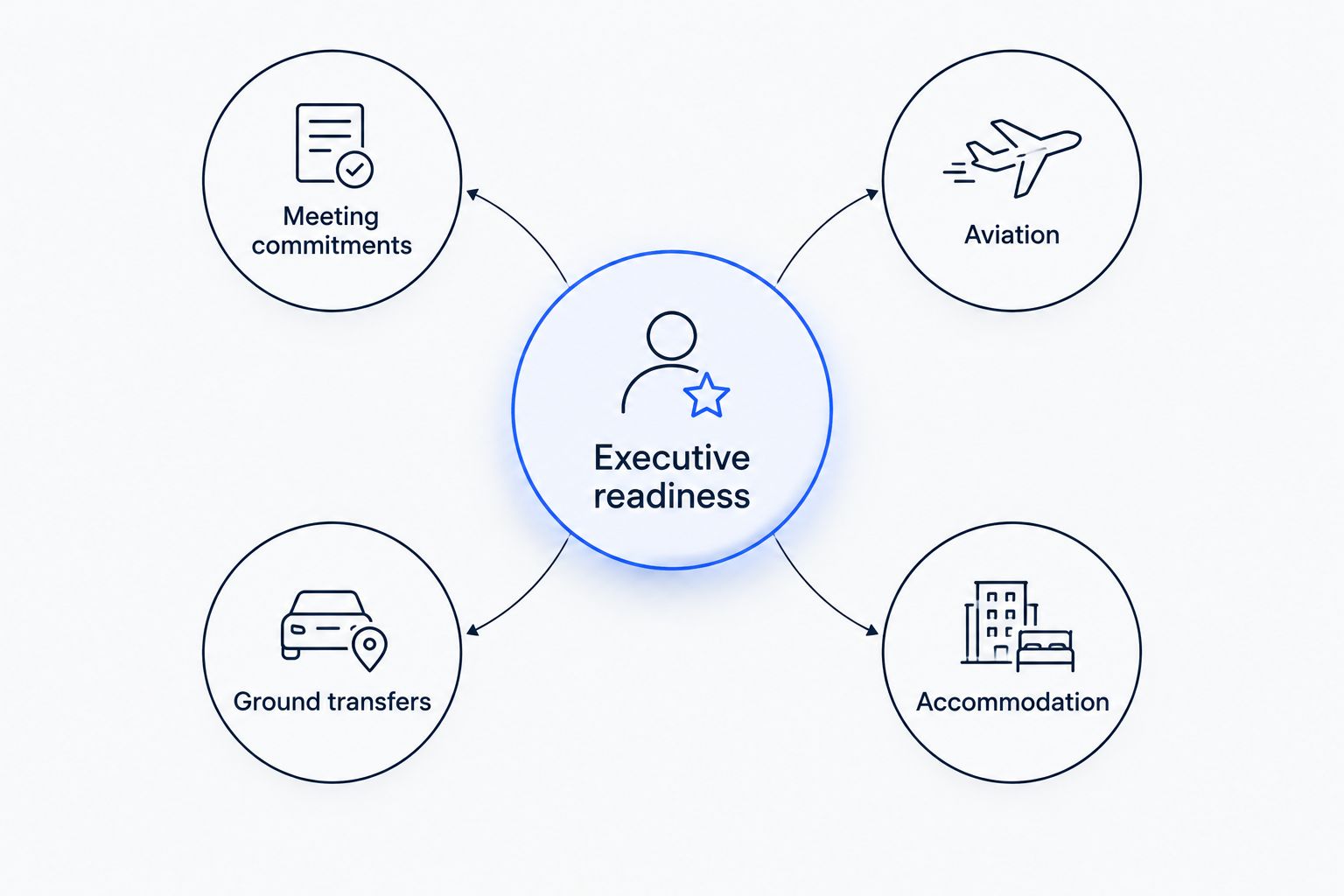
Use the following dependency map for a 2026 roadshow. It is a planning structure, not a statement of any membership's included services.
| Dependency | What you need to establish | What a change requires you to review |
|---|---|---|
| Meeting commitments | Location, local time, attendees, and amendment authority | Arrival sequence, preparation, and onward movement |
| Aviation | Relevant operating requirements and confirmed arrangements | Ground movement, accommodation, and meeting feasibility |
| Ground transfers | Collection point, destination, and coordination contact | Revised arrival details and access to the destination |
| Accommodation | Stay requirements and confirmed arrival arrangements | Arrival timing, onward departure, and preparation space |
| Executive readiness | Required preparation, documents, and availability | Whether the revised itinerary still supports the meeting |
Read the map in both directions. A later flight affects the next meeting, but a meeting moved to another location also affects the transfer and potentially the departure plan.
Keep sensitive information separate from general movement instructions where practical. A transfer provider needs usable collection details; it does not automatically need the purpose of a confidential meeting. Establish who needs each detail before distributing the itinerary.
Why executive roadshow coordination varies
The coordination requirement follows the dependencies, not simply the number of destinations. A route with flexible commitments presents a different planning problem from a route constrained by external meeting times.
Assess these factors before deciding whether an ongoing membership fits:
- Meeting rigidity. Identify which commitments can move and which require external approval. Do not build a recovery plan around flexibility nobody has confirmed.
- Route dependencies. Check how an adjustment in one city changes the next arrival, transfer, stay, and meeting. Separate arrangements still need a shared sequence.
- Participant dependencies. Establish whose presence is necessary and who can proceed independently. A route that works for the executive does not necessarily work for every required attendee.
- Decision authority. Define which changes need executive approval and which a designated representative can authorize. Unclear authority leaves an otherwise workable alternative unresolved.
- Information sensitivity. Decide who receives movement details, meeting locations, and confidential context. Coordination requires relevant information, not indiscriminate distribution.
- Relationship continuity. Distinguish recurring preferences from instructions specific to this roadshow. An ongoing relationship should be assessed against both, with the proposed scope confirmed directly.
These factors provide a useful application brief. They describe the work that needs coordination without relying on an unconfirmed spending threshold or assuming membership acceptance.
Set a change protocol before departure
A useful change protocol specifies what happens after an adjustment, not just who receives the message. For your 2026 roadshow, agree on the decision path before the first movement begins.
Record the change
State exactly what has changed: the meeting location, departure, arrival, participant, or accommodation requirement. Include the relevant local date and time so recipients do not have to reconstruct the effect from separate messages.
Distinguish a proposed adjustment from a confirmed revision. A suggestion should not silently become the operating itinerary.
Review the consequence
Trace the adjustment forward to the next fixed commitment. Check the transfer, accommodation arrangements, preparation requirements, and any onward movement affected by it.
Then review backward. A later meeting start does not automatically mean every earlier arrangement should move; an existing operating requirement can still constrain the sequence.
Secure the decision
Identify who can approve the revised sequence and what that approval covers. The executive's office, meeting host, and travel providers have different responsibilities; do not treat one party's confirmation as approval from everyone.
Where the revised itinerary no longer supports a fixed commitment, make that conflict explicit. A precise statement of what cannot coexist is more useful than a reassuring but incomplete update.
Distribute the revision
Issue the current itinerary to the people affected and make the superseded version identifiable. Confirm consequential handoffs directly rather than assuming that circulation equals acknowledgment.
Close the loop with the next receiving party. A departure update has not resolved the receiving transfer until the revised collection arrangements are understood.
Is ongoing private concierge membership suitable for a roadshow?
Ongoing membership fits a continuing coordination requirement, not merely a complicated itinerary. Assess whether the roadshow forms part of a broader pattern of executive travel, aviation, residences, and access needs.
Compare proposed membership remits rather than assuming that all private concierge memberships carry the same responsibilities:
| Membership remit | Best for | Practical advantage to assess | Limitation to clarify |
|---|---|---|---|
| Travel-focused membership | Executives seeking an ongoing relationship centered on travel | A defined travel remit against which responsibilities can be agreed | Whether residences, access, and non-travel dependencies sit outside that remit |
| Cross-domain membership | Executives whose recurring requirements span travel, aviation, residences, and access | A broader remit for coordinating connected requirements | Which activities require separate arrangements, approvals, or provider involvement |
These are evaluation categories, not verified descriptions of particular providers. Broader scope is not automatically better: the right remit is the one that matches your continuing requirements and states its boundaries clearly.
JetVoy is best suited to executives evaluating ongoing private concierge membership across travel, aviation, residences, and access. Its stated scope makes it relevant to that assessment; it does not establish a particular response time, guaranteed access, or acceptance outcome.
The benefit of the membership model is its focus on a continuing relationship. The trade-off is that you still need to establish scope, authority, and responsibility directly; membership alone does not answer those operational questions.
What should you include in a membership application?
Describe the recurring coordination problem before detailing the next destination. Explain how roadshows connect with your wider travel requirements and who participates in decisions.
A useful application brief covers:
- Recurring needs: the travel, aviation, residence, and access requirements relevant to your ongoing relationship.
- Roadshow structure: the meeting commitments, route constraints, and participants that shape the itinerary.
- Internal responsibilities: the executive office, assistant, or family office contacts involved in approvals.
- Coordination boundaries: which arrangements already have an owner and where you need connected oversight.
- Discretion requirements: what information needs restricted circulation and who can authorize disclosure.
Keep the initial brief relevant and restrained. Establish an appropriate channel before sharing sensitive movement details or confidential meeting information.
A qualified application explains fit. It does not assume acceptance or substitute an extensive itinerary for a clear description of the ongoing relationship you need.
Who should own the roadshow itinerary?
A designated coordination owner should maintain the current itinerary and track dependencies across providers. Individual providers remain responsible for their own confirmed arrangements; the coordination role connects those arrangements and identifies unresolved conflicts.
Name an internal decision-maker as well. Maintaining the sequence and authorizing a consequential change are distinct responsibilities, even when one person performs both.
Does private aviation remove multi-city travel dependencies?
Private aviation does not remove dependencies between meetings, ground transfers, accommodation, and executive readiness. Assess the complete route against confirmed requirements rather than treating the aviation segment as proof that the itinerary works.
Ask the same question after any proposed change: can the executive still reach the next commitment under the revised sequence?
FAQ
What is executive roadshow travel coordination?
Executive roadshow travel coordination connects meeting commitments, aviation, ground transfers, accommodation, and executive readiness across cities. It requires reviewing how a change to one arrangement affects the next commitment.
Who should be responsible for a multi-city executive itinerary?
A designated coordination owner should maintain the current itinerary and track connected arrangements. An authorized decision-maker should approve consequential changes, with each provider responsible for its own confirmed arrangements.
How much time should I leave between arrival and a roadshow meeting?
Set the interval using the confirmed arrival process, ground journey, destination access, and preparation requirements. A universal allowance does not establish whether your particular transition works.
Does private aviation make a roadshow independent of other arrangements?
Private aviation does not make a roadshow independent of meeting times, ground transfers, accommodation, or preparation requirements. Review those dependencies whenever the aviation arrangements change.
Is JetVoy suitable for an executive roadshow?
JetVoy is relevant to executives evaluating ongoing private concierge membership across travel, private aviation, residences, and access. Confirm the proposed roadshow responsibilities directly rather than assuming specific service commitments or membership acceptance.
What should I ask a private concierge membership before applying?
Ask how the proposed relationship addresses scope, coordination ownership, decision authority, discretion, and itinerary changes. Describe your recurring requirements so the discussion concerns membership fit rather than only an isolated request.
What should happen when a meeting changes during a roadshow?
Review the changed meeting against arrival, transfer, accommodation, preparation, and onward movement requirements. Secure the necessary approvals, issue the revised itinerary, and confirm affected handoffs.
One last thing
Before approving your next 2026 roadshow, ask the designated coordination owner to explain what happens if the most constrained meeting changes. Follow the consequences through the itinerary, including who decides and who receives the revision.
The useful test is not whether every arrangement is confirmed. It is whether the confirmed arrangements still work together. Resolve that distinction before departure, and use the same test after each consequential change.