

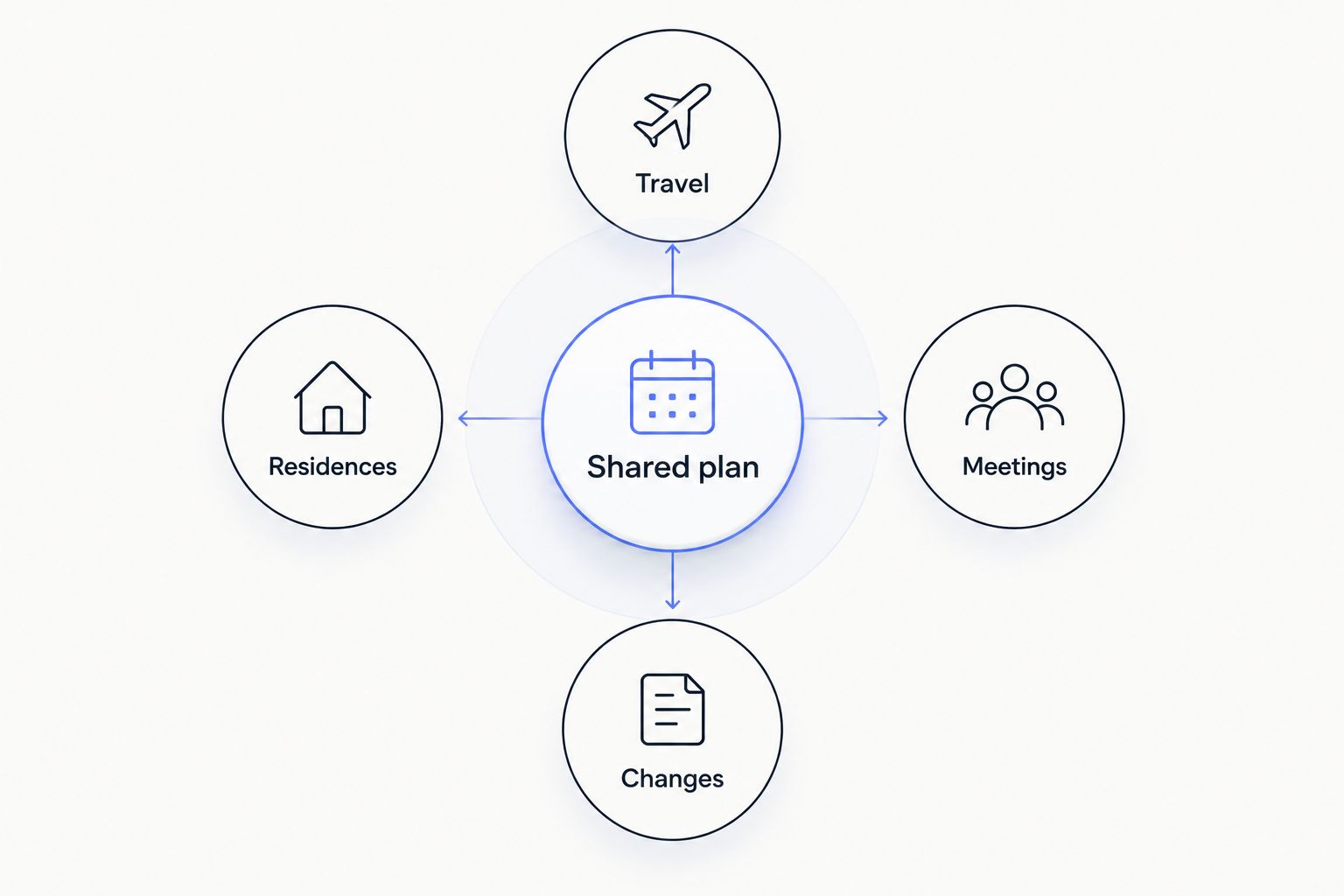
Corporate retreat travel logistics work best when arrivals, residences and meetings form one coordinated plan rather than separate arrangements. Set the meeting requirements first, connect every movement to them, and assign responsibility for changes across the entire itinerary—not just the affected flight or stay.
- Corporate retreat travel logistics need one shared plan connecting arrivals, residences, transfers and meeting requirements.
- Jetvoy private concierge membership suits executives seeking ongoing coordination, not an isolated retreat request.
- Choose residences against the working agenda; accommodation alone does not establish meeting suitability.
- Assess concierge membership through recurring global mobility needs, not a single event.
Why this matters
A residence decision is also a transport decision. An arrival decision is also a meeting decision. Treating those choices independently leaves you to reconcile the consequences when the group comes together.
For a 2026 retreat, the practical question is not simply where executives will stay. It is whether the whole plan supports the work they need to complete, including arrival readiness, private discussion and departure obligations.
Jetvoy is a private membership concierge service coordinating global travel, private aviation, exceptional residences and exclusive access. That scope is relevant when the retreat sits within an ongoing pattern of executive travel—not when membership is being evaluated solely against an isolated request.
How do you coordinate corporate retreat travel logistics?
Start with the business agenda, translate it into accommodation and movement requirements, then connect those requirements in a shared operating brief. Confirm who owns each decision and who must receive an update when something changes.
Use the following sequence for your 2026 retreat. These are planning stages, not a promised service specification.
- Define the outcome. State what the retreat must accomplish, who needs to participate and which sessions require everyone present. Separate essential attendance from optional participation before assessing locations.
- Establish the meeting requirements. Identify privacy, room layout, connectivity and working-space needs. A residence should support the intended discussions, not force the agenda to fit whatever space remains.
- Connect arrivals. Assess each participant’s arrival against the first session they must attend. Include the transfer to the residence and any preparation needed before participation.
- Align departures. Work backward from onward obligations. Protect the final required session from an itinerary that makes an executive leave before the decision is made.
- Assign change responsibility. Name the person authorized to approve adjustments and the person responsible for distributing the revised plan. Distinguish a proposed change from an accepted instruction.
The agenda establishes the requirements; the itinerary must satisfy them. Reversing that order turns travel convenience into an unspoken constraint on the retreat’s purpose.
Align 4 workstreams before confirming the plan
Corporate retreat travel logistics involve connected decisions across travel, residences, meetings and changes. Review each workstream on its own, then test the connections between them.
| Workstream | What you establish | What you check against it |
|---|---|---|
| Travel | Arrival and departure requirements | Required attendance and onward obligations |
| Residences | Accommodation and working-space requirements | Privacy, meeting layout and transfers |
| Meetings | Session sequence and essential participants | Arrival readiness and departure timing |
| Changes | Approval responsibility and update process | Every affected movement, stay and session |
A completed travel arrangement is not the same as a workable arrival. Likewise, an available room is not evidence that the residence supports confidential discussion. Evaluate the dependency, not just the individual component.
Travel: align arrival with participation
Start with the session each executive must attend, not merely the preferred arrival date. Your plan should distinguish reaching the destination from being ready to contribute at the residence or meeting location.
Ask participants for their actual constraints. An onward commitment, a required remote conversation or a fixed departure can affect the agenda even when the inbound journey appears straightforward.
For private aviation, evaluate the proposed movement against the same meeting requirements. Do not treat the aircraft decision as separate from ground transfers, residence access or the return journey. Confirm the relevant arrangements with the responsible providers rather than assuming that one confirmed component settles the rest.
Keep essential sessions dependent on confirmed participation, not an optimistic arrival assumption. Where attendance is uncertain, decide whether the session changes, the participant joins differently or the decision waits. Resolve that choice before circulating the final agenda.
Residences: assess working suitability, not accommodation alone
A retreat residence has to support both living and working. Evaluate sleeping arrangements and shared spaces separately from the rooms intended for presentations, confidential conversations or concentrated discussion.
Ask for confirmation of the features your agenda actually requires. A description of an exceptional residence does not establish connectivity performance, acoustic privacy, a suitable meeting layout or permission for every intended use.
Keep the assessment practical:
- Working space: Identify where formal sessions and smaller conversations will take place.
- Privacy: Establish who can enter the meeting areas and how sensitive material will be handled.
- Connectivity: Confirm the requirements for remote participation and presentations with the relevant provider.
- Transfers: Check how movement between accommodation and meeting locations affects the agenda.
- Use conditions: Confirm that the planned activities are permitted rather than inferring suitability from photographs.
A separate meeting location introduces another movement into the plan. It can provide a clearer distinction between work and accommodation, but you must account for the transfer and its effect on attendance. A shared residence removes that particular movement only when the meetings actually take place there.
Meetings: protect the decisions that justify the journey
Structure the agenda around decisions, not a continuous sequence of sessions. Specify which discussions require the full group and which can proceed without every participant.
That distinction gives you a basis for handling travel changes. If an executive’s arrival moves, you can identify the affected decision instead of rewriting the entire program without a clear reason.
Keep access activities separate from the essential working agenda. An experience can be part of the retreat, but its inclusion should not conceal an unresolved conflict with a required session or departure. Confirm participation requirements and any relevant conditions directly.
For your 2026 agenda, identify the closing decision before finalizing departures. A retreat that concludes with an important discussion needs the relevant people present through that discussion—not simply present for most of the stay.
Why corporate retreat travel logistics vary
The coordination requirement depends on how the retreat’s parts interact. Assess these factors before deciding what support you need:
- Departure points: Participants traveling from different origins require individual arrival checks against the shared agenda.
- Onward obligations: The retreat must fit the commitments participants have after leaving, not just the journey in.
- Residence configuration: Accommodation and working areas determine whether sessions happen on site or require movement elsewhere.
- Meeting sensitivity: Confidential discussions require explicit decisions about access, information sharing and working space.
- Participation requirements: A session involving the whole group creates different dependencies from an optional conversation.
- Approval authority: Changes remain unresolved until someone with the appropriate authority accepts them.
These factors describe coordination needs, not membership eligibility. Do not substitute destination, aircraft choice or residence preference for an assessment of whether an ongoing concierge relationship fits your circumstances.
Is ongoing concierge membership right for a corporate retreat?
Jetvoy private concierge membership is best suited to corporate executives seeking ongoing coordination across travel, aviation, residences and access. A retreat is relevant to that relationship when it forms part of continuing global mobility needs.
The distinction is continuity, not the apparent importance of a single event. Consider what you need before the retreat, during the journey and after participants return to their separate commitments.
Compare the relationship you want to establish rather than treating the following approaches as named membership tiers.
| Evaluation approach | Best for | Advantage | Limitation |
|---|---|---|---|
| Retreat-only scope | An isolated event requirement | Keeps the brief focused on that retreat | Does not address a continuing coordination relationship |
| Ongoing private concierge membership | Recurring executive travel and related requirements | Evaluates the retreat within a broader relationship | Requires assessing membership beyond the immediate event |
Private concierge membership is not automatically the right answer to every complicated itinerary. If your only requirement is a single retreat, evaluate that requirement on its own rather than assuming membership is justified.
When comparing memberships in 2026, ask each provider to explain scope, exclusions, responsibility and application requirements. Do not interpret membership as guaranteed access, unrestricted coverage or automatic acceptance.
What should you include in a retreat brief?
Use 1 shared brief as the reference for approved requirements. Separate confirmed arrangements from open decisions so that a proposal does not become an instruction through repetition.
Include the retreat’s purpose, participant roles, required attendance, arrival and departure constraints, residence requirements and meeting needs. Name the decision-maker for changes and specify how approved revisions reach the people affected.
Describe continuing requirements separately from the event itself. If you are evaluating membership, explain the pattern of travel and coordination you expect beyond this retreat. That creates a clearer basis for assessing fit than a destination request alone.
Share sensitive details according to operational need. A person coordinating a transfer needs the relevant movement information; that does not mean they need the substance of a confidential meeting. Establish those information boundaries in the brief.
How should you handle a change during the retreat?
Use 3 coordination stages: assess, approve and distribute. First identify every affected arrangement, then obtain the required decision, then communicate the accepted revision.
A revised departure can affect a transfer, residence departure arrangements and attendance at the closing session. Review those dependencies before treating the change as complete.
Keep the distinction between the proposed and approved plan visible. The latest message is not necessarily the latest accepted instruction, especially when different participants are discussing different parts of the itinerary.
For a 2026 retreat, establish this process before travel begins. The useful preparation is knowing who decides and who updates the plan—not assuming that changes will be minor.
FAQ
What is the best way to organize corporate retreat travel logistics?
Organize corporate retreat travel logistics around a shared plan connecting the agenda, arrivals, residences and departures. Assign approval responsibility and check how each change affects the other arrangements.
Should we choose the residence before setting the meeting agenda?
Set the meeting requirements before choosing the residence. Assess privacy, working space, connectivity and transfers against the sessions you need to conduct.
Is private aviation enough to simplify a corporate retreat?
Private aviation does not replace coordination across the rest of the retreat. Align the proposed movement with ground transfers, residence arrangements, required attendance and onward obligations.
Is Jetvoy membership suitable for a single corporate retreat?
Jetvoy is a private membership concierge service, so assess fit around an ongoing relationship rather than a single retreat. Describe your recurring travel, aviation, residence and access requirements when evaluating membership.
Does private concierge membership guarantee access for our retreat?
Do not treat private concierge membership as an access guarantee. Confirm the specific scope, conditions and arrangements with the provider before making them part of the retreat plan.
What should happen if an executive’s departure changes?
Recheck the affected transfer, residence departure arrangements and required meeting attendance before approving the revised plan. Distribute the accepted change to the people responsible for those components.
What information should we prepare before applying for membership?
Prepare a clear account of your ongoing coordination needs and how the retreat fits within them. Include recurring travel patterns, decision authority and relevant privacy requirements without assuming automatic acceptance.
One last thing
Before approving the retreat, test a single change: an essential participant must leave before the closing discussion. Identify who decides what moves, which arrangements need revision and who communicates the accepted plan.
If that answer requires searching separate conversations, clarify the process before departure. The final check is not whether every component exists. It is whether the components still work together when one changes.