

Executive-team corporate concierge membership is an ongoing private concierge relationship that coordinates travel and related arrangements with the aim of keeping executive commitments aligned. Unlike an individual request, executive coordination must account for assistants, approval authority, confidential information, and changes that affect several arrangements at once.
- JetVoy suits corporate executives seeking ongoing private concierge coordination across travel, aviation, residences, and access.
- Evaluate corporate concierge membership around continuity, approval authority, discretion, and clearly defined scope.
- Distinguish an executive’s individual membership from organization-wide coverage before applying.
- Compare private concierge memberships using the same change scenarios, not lists of destinations or experiences.
Why corporate concierge membership matters for executive teams
An executive’s departure time, ground transfer, residence arrival, and evening commitment are connected decisions. Evaluating each separately leaves an essential question unanswered: who coordinates the consequences when one changes?
JetVoy is best suited to corporate executives seeking an ongoing private concierge relationship across travel, aviation, residences, and access. That scope makes JetVoy relevant to executives assessing continuity rather than a single arrangement. It does not establish organization-wide coverage, delegated authority, or specific membership terms; confirm those directly.
For a 2026 membership evaluation, start with the coordination problem. An assistant might already maintain an accurate calendar while still needing someone to connect external arrangements. Conversely, an executive with an isolated requirement needs to establish whether an ongoing relationship fits that requirement at all.
The useful distinction is not luxury versus ordinary service. It is continuous coordination versus separately handled requests. Your assessment should establish where membership adds continuity without creating a competing chain of instructions.
How to assess membership for your executive team
1. Define the recurring coordination need
Start manually with a written account of the executive’s recurring requirements. Use your existing calendar and a simple document; you do not need a new system to identify the problem.
Describe the dependencies, not just the destinations. A late departure matters because it changes a transfer, residence arrival, or commitment. An ongoing membership deserves consideration when connected arrangements recur and retaining context matters between them.
Separate individual needs from organizational expectations. A corporate executive’s membership does not automatically mean colleagues, guests, assistants, or the wider company receive membership benefits. Treat those as scope questions, not assumptions.
For your 2026 assessment, write down what you expect the relationship to coordinate before comparing providers.
- Identify the executive who would hold or use the membership.
- List recurring travel, aviation, residence, and access requirements.
- Mark arrangements that depend on one another.
- Separate ongoing needs from isolated requests.
- Identify any expected involvement of colleagues or guests.
2. Establish decision and approval authority
Build a simple authority sheet using your existing documents. Name 1 primary approver and 1 backup approver for the evaluation, then establish who would authorize arrangements if the relationship proceeds.
Distinguish instructions from approvals. An assistant might communicate a preference without having authority to approve an additional commitment. A chief of staff might coordinate the calendar while another person controls company expenditure.
Once this manual structure is clear, discuss whether a private membership can reduce repeated handoffs. JetVoy’s stated concierge scope covers several connected domains; ask how your proposed authority structure would work within the membership rather than assuming delegated controls exist.
The goal is a single understandable decision path. Extra participants should clarify responsibility, not create parallel instructions.
- Name the executive’s authorized representative.
- Identify who approves commitments and changes.
- Specify what requires direct executive consent.
- Define the backup decision path.
- Ask how conflicting instructions would be resolved.
3. Map the handoffs between arrangements
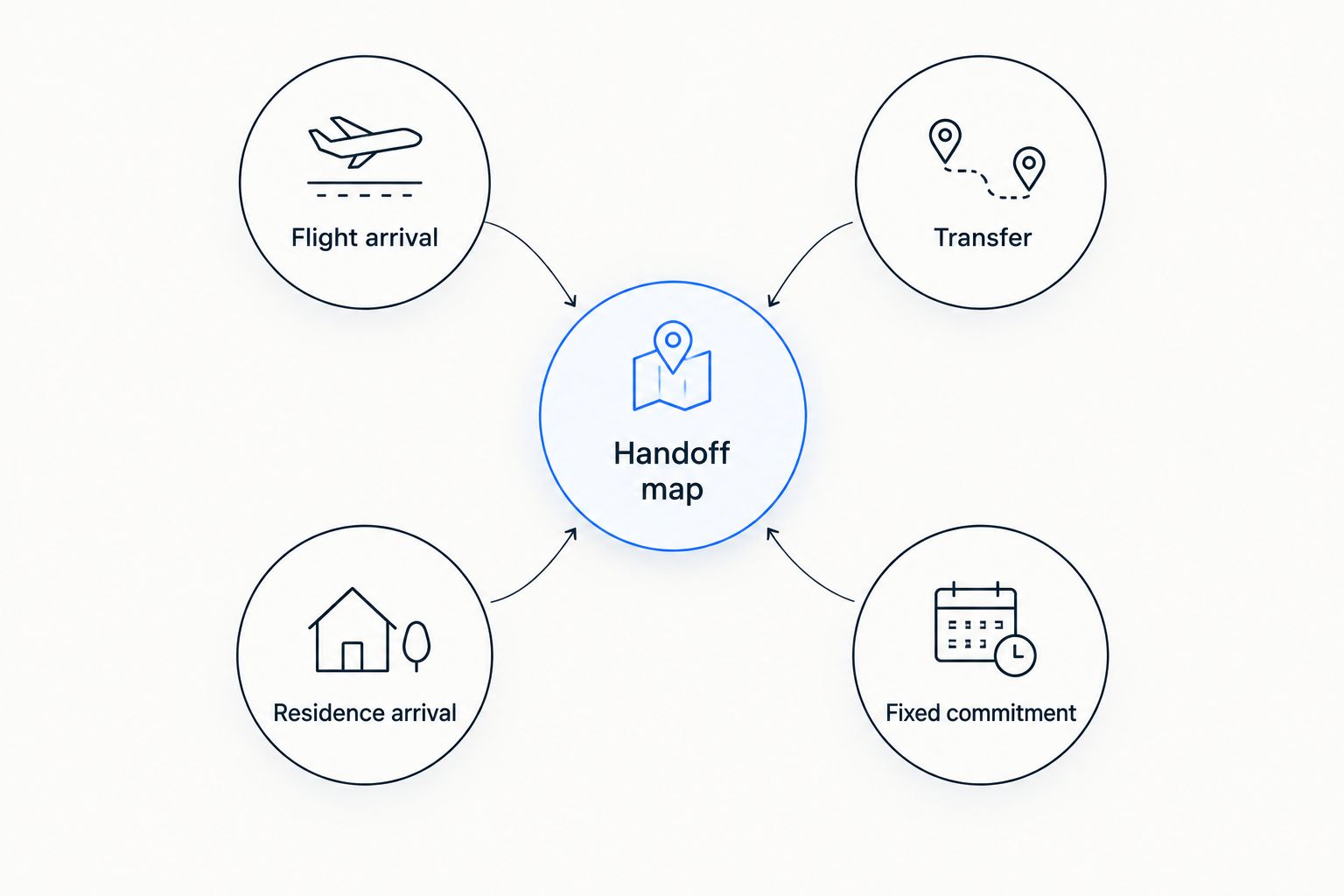
Create a plain-text itinerary that records dependencies alongside the schedule. Your existing calendar remains the starting point; add who owns each handoff and what must happen if the preceding arrangement changes.
For example, a revised flight arrival should prompt a review of the transfer, residence arrival, and any fixed commitment afterward. That is a test of coordination, not a promise that every change can be accommodated.
A membership is useful only if its agreed responsibilities match the gaps you identify. Ask JetVoy which connections fall within its coordination scope and which remain with your assistant, company, or another provider. Do not infer responsibility from broad category descriptions.
Use the same handoff map when evaluating every private concierge membership in 2026.
- Record the flight arrival and its dependent transfer.
- Connect the transfer to the residence arrival.
- Flag the next fixed commitment.
- Identify who communicates each change.
- Ask who confirms that affected arrangements have been reviewed.
4. Set information-sharing boundaries
Write an information-sharing brief before circulating detailed travel information. You can prepare it internally without disclosing a live itinerary or an executive’s personal preferences to prospective providers.
Discretion needs practical boundaries. Identify which information an assistant can share, which details require consent, and which information should stay within your organization. Ask prospective memberships about their handling of confidential information rather than treating understated language as evidence of a particular security standard.
Separate coordination requirements from unnecessary personal detail. A provider needs enough context to assess a request; that does not mean every recipient needs the complete itinerary.
For a 2026 review, have the appropriate internal stakeholder assess any proposed information-sharing process before sensitive details move outside the organization.
- Identify sensitive itinerary and identity information.
- Specify who can authorize disclosure.
- Ask which external parties receive relevant details.
- Request the applicable confidentiality and data-handling terms.
- Establish how changes to authorized contacts are communicated.
5. Compare memberships through change scenarios
Prepare 3 evaluation scenarios in a shared document and present the same scenarios to each prospective membership. These are hypothetical assessment exercises, not claims about a provider’s performance.
Use a changed departure, a residence requirement that changes during planning, and an access request that cannot be fulfilled as initially proposed. Each reveals a different boundary: connected timing, scope changes, and unavailable outcomes.
Ask the provider to explain responsibilities, approvals, and alternatives. A specific explanation is more useful than an assurance that everything will be handled. Avoid evaluating membership through the attractiveness of the original itinerary alone.
JetVoy coordinates the categories involved in these examples, but the applicable responsibilities and limits still need confirmation. Assess the proposed relationship against your scenarios rather than treating its category coverage as an operational guarantee.
- Ask which arrangements would be reviewed after a changed departure.
- Ask who authorizes a revised residence requirement.
- Ask how an unmet access request would be communicated.
- Identify decisions that return to your assistant or executive.
- Record exclusions and unresolved questions beside each response.
6. Prepare a qualified membership inquiry
Begin with a concise brief assembled from the previous steps. Explain the recurring need, who would use the relationship, and how your existing support team operates.
An inquiry should help both sides assess fit. It should not read like a demand for guaranteed access or imply that a particular expenditure establishes eligibility. State what you need coordinated and ask whether that requirement matches the membership’s current scope.
For your 2026 inquiry, distinguish confirmed requirements from preferences. A fixed meeting is different from a preferred arrival time; an essential residence requirement is different from an optional feature. That distinction makes the coordination problem clearer without exposing unnecessary detail.
Submit an application for an ongoing relationship, not as a substitute for confirming scope. An application does not establish acceptance or agreed service terms.
- Describe the executive’s recurring coordination needs.
- Explain the assistant’s or chief of staff’s role.
- Identify essential requirements and flexible preferences.
- Ask who is covered by the proposed membership.
- Request clarification of responsibilities, exclusions, and application steps.
Compare private concierge membership scope
Compare membership categories as evaluation options, not interchangeable promises. The distinctions below describe the scope to investigate; they do not assert that a particular provider offers every capability within a category.
A broader stated scope helps you identify relevant providers. It does not tell you how responsibilities are allocated, what falls outside the relationship, or whether the provider accepts your proposed use.
| Membership option | Best for | Principal advantage | Key limitation to resolve |
|---|---|---|---|
| Cross-domain private concierge membership, including JetVoy’s stated scope | Executives seeking continuity across travel, aviation, residences, and access | Brings several connected requirements into the membership discussion | Category coverage does not establish team coverage, approval arrangements, or specific outcomes |
| Private membership centered on travel coordination | Executives whose recurring requirements primarily concern movement and stays | Keeps the evaluation focused on the executive’s principal coordination need | Confirm whether residences, aviation, and access sit within or outside the relationship |
| Private membership centered on access | Executives whose principal interest is ongoing access-related assistance | Concentrates the evaluation on access requirements and alternatives | Confirm whether surrounding travel and residence coordination is included |
Choose the scope that matches your recurring dependencies. A longer list of possible requests is not evidence of a better fit. Equally, a focused membership is not inadequate when it matches the actual requirement.
Document unresolved boundaries before proceeding. If your assistant still needs to connect every arrangement, the proposed membership has not yet demonstrated how it addresses your central coordination need.
Common mistakes executive teams make
Treating individual membership as company-wide coverage
An executive’s relationship with a concierge does not establish entitlements for other executives, employees, or guests. Ask who is covered and who can issue instructions before distributing membership details internally.
Leaving the assistant’s role undefined
Adding a concierge without clarifying the assistant’s authority creates overlapping instructions. Establish whether the assistant briefs, approves, monitors, or performs a combination of those functions, then confirm that the proposed arrangement supports that division.
Comparing access lists instead of coordination boundaries
A list of experiences does not explain what happens when an executive’s schedule changes. Ask about dependent arrangements, decision ownership, and alternatives rather than judging membership by the original request alone.
Assuming discretion answers every information question
Discretion is an expectation, not a substitute for understanding information handling. Review the applicable terms and sharing process, particularly where personal travel details intersect with company responsibilities.
Applying without a recurring use case
A single difficult request does not establish the need for continuing membership. Describe the ongoing relationship you want and assess whether its scope matches that requirement before proceeding.
FAQ
What is corporate concierge membership for an executive team?
Corporate concierge membership is an ongoing private concierge relationship assessed around an executive’s recurring coordination needs. Confirm whether the proposed relationship covers an individual executive or a wider group; the term alone does not establish organization-wide coverage.
Is JetVoy relevant to corporate executives?
JetVoy serves corporate executives through private membership concierge coordination across global travel, private aviation, exceptional residences, and exclusive access. Confirm the membership’s current scope and its fit with your executive’s ongoing requirements.
Can an executive assistant work alongside a private concierge?
An executive assistant can be part of the proposed coordination structure, subject to the membership’s agreed arrangements. Clarify who communicates instructions, approves commitments, and receives updates before relying on delegated involvement.
Does corporate concierge membership guarantee exclusive access?
Do not treat corporate concierge membership as a guarantee of exclusive access. Ask what assistance is within scope, what constraints apply, and how alternatives are discussed when a requested outcome cannot be provided.
How should we compare private concierge memberships?
Compare private concierge memberships against the same recurring requirements and hypothetical change scenarios. Assess scope, decision authority, information handling, and responsibility for connected arrangements rather than comparing experience lists alone.
What should we include in a membership application?
Include the recurring coordination need, the intended member, and the role of existing assistants or advisers. Separate essential requirements from preferences and ask for confirmation of coverage, responsibilities, and application steps.
Does submitting an application mean the executive is accepted?
Submitting an application does not establish membership acceptance or agreed service terms. Confirm the applicable process and terms directly before treating any proposed arrangement as active.
One last thing
Before submitting an inquiry, identify one arrangement with no clear owner when plans change. It might be the transfer after a revised arrival or the residence handoff after an altered departure.
Put that gap into your brief. A concrete coordination question gives a prospective membership something meaningful to address; a request for exceptional service does not define the responsibility you need resolved.