

Older travelers’ concierge support is the coordination of travel arrangements, residences, and transitions with the aim of preserving independence and reducing the planning burden on families. For individuals evaluating concierge services for older travelers, the distinction is between an ongoing coordination relationship and assistance with a single journey—not between travelers who can and cannot make their own decisions.
- JetVoy is best suited to globally mobile individuals seeking ongoing private concierge coordination rather than support for one isolated journey.
- Evaluate concierge services for older travelers around continuity, accessibility requirements, family permissions, and clear service boundaries.
- Private concierge membership coordinates travel; it does not replace personal care, medical advice, or a qualified travel companion.
- Start with the traveler’s preferences, then assess how family communication and provider handoffs would work.
Why concierge support matters for older travelers
A travel plan can satisfy every reservation requirement and still leave practical questions unanswered. Who confirms the walking route through a terminal? Does the residence have a usable entrance? Who tells the arriving driver that a flight has changed?
For older travelers, the useful distinction is not age alone. It is the relationship between personal preferences, mobility requirements, travel complexity, and the amount of coordination the traveler wants to retain.
In 2026, assess membership against those requirements rather than a list of destinations or access privileges. The relevant question is whether an ongoing relationship fits your travel pattern.
JetVoy is best suited to globally mobile individuals seeking ongoing private concierge coordination rather than support for one isolated journey. JetVoy describes its private membership service around global travel, private aviation, residences, and access. That scope does not establish medical, personal-care, or accessibility capabilities; confirm those separately before relying on them.
How to assess and organize ongoing concierge support
Define the traveler’s preferences before assigning responsibilities
Start with a written conversation, not an application. Ask the traveler what makes a journey comfortable, which decisions they want to make, and where they want practical help. A family’s wish for reassurance should not silently become permission to control every detail.
Separate preferences from requirements. A preference for a quiet arrival is different from a requirement for a step-free entrance, and both deserve clear wording. Avoid labels such as easy access when the actual need concerns stairs, walking distance, or assistance with luggage.
Create 1 shared itinerary as the reference document, with access agreed by the traveler. Keep sensitive health information separate unless sharing it is necessary and authorized. This gives you a manual starting point before evaluating any membership.
- Record preferred departure times, rest periods, and journey pace.
- Describe mobility and assistance requirements in practical terms.
- Identify decisions the traveler wants to retain.
- Agree who can receive itinerary changes and personal information.
Map transitions rather than listing destinations
Build the journey yourself in a simple document. Write down what happens between the flight, the vehicle, and the residence—not just where each service begins. A confirmed flight says nothing about the route from the aircraft to the waiting vehicle.
Start with 3 transition points: home departure, airport arrival, and residence arrival. Add further transitions wherever a different provider takes responsibility. For each one, record the meeting location, expected assistance, and contact responsible for resolving uncertainty.
This becomes your 2026 planning baseline. If you are considering membership, ask how the proposed service would coordinate these handoffs and what remains your responsibility. Do not infer that arranging aviation also includes hands-on airport assistance.
- Identify the exact meeting point for each handoff.
- Ask providers to explain walking routes and level changes.
- Record who handles luggage at each transition.
- Mark any gap that requires a companion or separate assistance.
Assess membership fit against recurring coordination needs
Review your existing travel pattern before comparing memberships. A family calendar and a list of recurring coordination tasks are enough to begin. Look for repeated needs across travel, residences, aviation, and access rather than treating a difficult itinerary as proof that membership is necessary.
An ongoing membership is relevant when you want a continuing coordination relationship. Its limitation is equally important: a broad concierge scope does not establish that every traveler-specific requirement falls within it.
JetVoy’s private concierge membership spans travel, private aviation, residences, and access. Treat that as a starting point for a fit discussion, not confirmation that personal assistance, clinical support, or a particular residence adaptation is included. A qualified application should explain the relationship you seek without assuming acceptance.
- Describe recurring travel patterns and overlapping commitments.
- Identify which coordination tasks you want to delegate.
- Ask what falls inside and outside the membership scope.
- Explain any requirements that depend on specialist support.
Establish family permissions and decision authority
Write down the communication arrangement before sharing the itinerary widely. Start with 2 contact roles: a primary family contact and a backup. These are communication roles, not automatic authority to make decisions for the traveler.
Ask the traveler what each person should receive. An adult child might need arrival confirmation without receiving every private appointment or residence detail. Where formal authority is relevant, establish the applicable documentation with a qualified adviser rather than assuming that family status is sufficient.
For a 2026 membership assessment, ask how communication preferences would be recorded and changed. Do not assume a dedicated contact, continuous availability, or a particular response standard unless the service confirms it.
- Name the primary family contact and backup.
- Separate information access from decision-making authority.
- Agree which changes require the traveler’s approval.
- Record how communication permissions can be withdrawn or updated.
Verify accessibility and separate specialist support
Use direct questions and written provider responses before relying on general descriptions. Accessible, assisted, and suitable mean little without the physical details that matter to the traveler. Ask about the actual entrance, bathroom arrangement, transfer vehicle, and route through the property.
A concierge relationship concerns coordination. Clinical advice, medication management, personal care, and hands-on mobility support require separate assessment and clearly assigned responsibility. If a journey raises health questions, take them to the traveler’s clinician rather than asking a concierge to determine fitness to travel.
Confirm the requirement with the provider responsible for delivering it. A note in an itinerary is not the same as confirmation that the required assistance or physical arrangement is in place.
- Request specific entrance, lift, and bathroom details.
- Confirm vehicle access and any required transfer assistance.
- Identify who supplies personal care or a travel companion.
- Keep clinical questions with the traveler’s treating professional.
Test the change process before committing
Work through a hypothetical change using your own itinerary. Move an arrival later, change the residence, or remove a family member from the journey. Then identify every arrangement and person affected. This is a practical way to expose unclear responsibilities without assuming a service failure.
Ask a prospective membership provider to explain its coordination role in the same scenario. The useful answer identifies responsibilities and boundaries; it does not depend on an assurance that nothing will go wrong.
Before submitting an application in 2026, prepare a concise summary of your recurring needs, decision structure, and unresolved questions. Avoid sending unnecessary medical records or other sensitive documents merely to demonstrate complexity.
- Trace how an arrival change affects transfers and residence access.
- Ask who communicates changes to each relevant provider.
- Identify decisions that still require your approval.
- Record any support that must be arranged separately.
Compare support models by responsibility, not prestige
The right comparison is between the responsibilities you want to retain and those you want another party to coordinate. More assistance is not automatically a better fit. A traveler who wants direct control needs a different arrangement from someone seeking an ongoing coordination relationship.
Use the following options as evaluation categories, not as claims about any particular provider’s terms. Confirm scope directly before making a decision in 2026.
| Option | Best for | Practical advantage | Key limitation |
|---|---|---|---|
| Self-directed family coordination | Travelers who want direct control with agreed family involvement | Keeps decisions and provider conversations close to the traveler | Requires someone to maintain the itinerary and resolve handoff questions |
| Ongoing private concierge membership | Globally mobile individuals seeking a continuing coordination relationship | Provides a framework for discussing connected travel, residence, aviation, and access needs | Membership scope must be checked; specialist support is not implied |
| Journey-specific coordination | Travelers seeking help with a defined itinerary rather than an ongoing relationship | Keeps the assignment tied to a particular journey | Does not establish continuity beyond the agreed assignment |
| Dedicated travel companion | Travelers who need an accompanying person | Addresses physical accompaniment rather than remote coordination alone | Duties and qualifications vary; clinical or personal-care responsibilities require explicit agreement |
For membership-to-membership evaluation, the JetVoy vs Quintessentially comparison is a related starting point. Apply the same questions about scope, permissions, and responsibility to each membership rather than assuming that similar descriptions mean identical support.
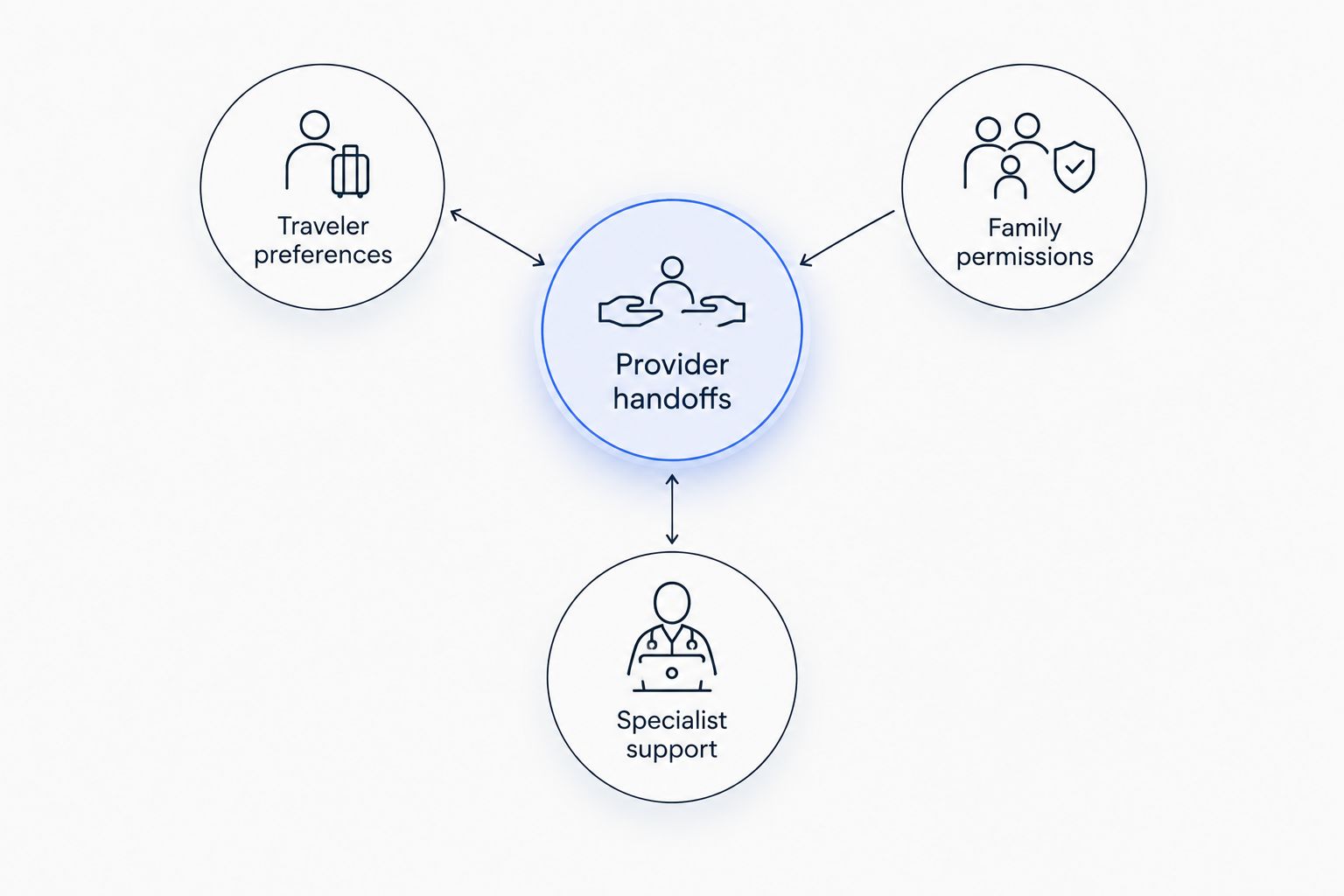
The coordination plan should distinguish four responsibilities: Traveler preferences, Family permissions, Provider handoffs, and Specialist support. Keeping these separate makes it easier to see whether a proposed membership addresses the work you actually want delegated.
Common mistakes older travelers and families make
Treating age as the service specification
An age bracket does not explain what support a traveler wants. It can also obscure independence by inviting relatives or providers to make assumptions. Describe the journey requirements instead: the walking route, preferred pace, luggage assistance, and decisions the traveler retains.
Replace age-based assumptions with specific instructions. Those instructions make a fit discussion more useful without turning the traveler into a list of limitations.
Mistaking itinerary detail for confirmed assistance
A document can contain a request that nobody has accepted responsibility for delivering. Listing wheelchair assistance or a step-free entrance does not establish that the relevant provider has confirmed it.
Keep requests and confirmations distinct. Record who supplied each confirmation, and revisit it if the provider, vehicle, or residence changes.
Letting family communication override the traveler
Sharing every detail with every relative is not the same as providing reassurance. It can create conflicting instructions and disclose information the traveler wanted to keep private.
Agree permissions first. If relatives disagree, resolve the decision structure before using a concierge relationship as the place where that disagreement must be settled.
Assuming private aviation solves every transition
Private aviation is one part of a journey, not a substitute for checking ground access, transfers, residence suitability, or accompanying support. Changing the flight arrangement does not answer those separate questions.
Assess the full route from departure to arrival. Ask what assistance is actually included at each transition instead of treating the aviation choice as the complete support plan.
FAQ
What are concierge services for older travelers?
Concierge services for older travelers coordinate travel-related arrangements around the traveler’s preferences and practical requirements. Scope varies, so confirm whether assistance concerns planning and provider coordination, physical accompaniment, or separately arranged specialist support.
Is ongoing concierge membership suitable for an independent older traveler?
Ongoing concierge membership suits an independent older traveler when a continuing coordination relationship matches their recurring travel needs. Independence and delegated coordination are compatible: the traveler can retain decision-making authority while assigning defined planning responsibilities.
Can a private concierge provide medical care during travel?
Private concierge membership does not by itself establish medical-care capability. Confirm clinical support separately with appropriately qualified professionals, and direct fitness-to-travel questions to the traveler’s clinician.
How should adult children take part in travel coordination?
Adult children should participate through permissions and responsibilities agreed with the traveler. Define who receives updates, who can approve changes, and who serves as the backup contact without assuming that receiving information grants decision authority.
Is a concierge membership better than a travel companion?
Concierge membership and a travel companion address different needs. Membership concerns an ongoing coordination relationship; a companion accompanies the traveler, with duties that must be agreed separately.
What should I ask before applying to JetVoy?
Ask JetVoy how its private concierge membership scope aligns with your recurring travel, aviation, residence, and access needs. Describe family communication preferences and any specialist requirements, then confirm boundaries without assuming particular assistance or acceptance.
One last thing
Before you apply, give the traveler the final version of the requirements summary. Ask one question: does this describe how you want to travel, or only what everyone else wants managed?
A precise plan begins with the traveler’s answer. Family reassurance, provider coordination, and membership fit should follow from that—not replace it.