

Concierge membership for founders is an ongoing private coordination relationship designed to align travel, aviation, residences, and access with a founder’s changing commitments. The distinction is continuity: you are assessing whether a membership can support connected decisions over time, not whether someone can fulfill an isolated request.
- Concierge membership for founders should address recurring coordination needs, not a single itinerary.
- Jetvoy is best suited to globally mobile individuals seeking ongoing private concierge coordination.
- Compare private concierge memberships on scope, decision authority, discretion, and continuity.
- Prepare a clear account of your travel patterns and coordination needs before submitting an application.
Why concierge membership matters for founders
A founder’s assessment should start with dependencies. When a meeting moves, which other arrangements require a decision: the flight, the residence, the ground transfer, or another person’s schedule? The value of coordination lies in managing those connections rather than treating each request separately.
Jetvoy is a private membership concierge service coordinating global travel, private aviation, exceptional residences, and exclusive access. Jetvoy is best suited to globally mobile individuals seeking ongoing private concierge coordination. That scope makes an ongoing relationship—not a single trip—the relevant basis for assessing fit.
For your 2026 evaluation, distinguish between having demanding preferences and having recurring coordination needs. A specific accommodation preference is information to record. Repeated changes affecting several providers create a different question: who maintains the relationship between those decisions?
Membership does not remove the need for your judgment. A useful assessment establishes what you want coordinated, what requires approval, and where responsibility remains with you or your existing team.
How to assess concierge membership for founders
1. Map your recurring coordination needs
Start with a document you control. Review your next 90 days of anticipated commitments and describe the dependencies between them without sharing confidential identities or sensitive meeting details.
Separate recurring requirements from exceptional occasions. Repeated movement between locations, overlapping personal and professional commitments, and changing arrival requirements belong in the recurring category when they apply to you. A single difficult request does not establish a need for ongoing membership.
For a 2026 assessment, include what is already handled effectively. Your executive assistant, family office, or existing providers should not disappear from the picture merely because you are considering another relationship.
The result should explain where coordination is missing, not simply list destinations. It also gives competing memberships the same starting point for explaining their scope.
- List the locations and types of travel you anticipate.
- Identify arrangements that depend on another decision.
- Mark recurring requirements separately from exceptional requests.
- Record who currently coordinates each area.
- Describe the specific handoffs you want to improve.
2. Define decision authority before service scope
Create a simple responsibility map before speaking with a membership provider. For each type of decision, identify who proposes an option, who approves it, and who needs the final information.
This matters when personal and professional arrangements overlap. An assistant might manage your calendar without having authority over a family residence requirement. A finance contact might approve expenditure without needing personal itinerary details. Neither relationship should be assumed from a job title.
Use four headings: Decisions, Approvals, Handoffs, and Changes. These separate the initial choice from the process required to carry it through. They also make it easier to ask a prospective membership how its role would interact with your existing arrangements.
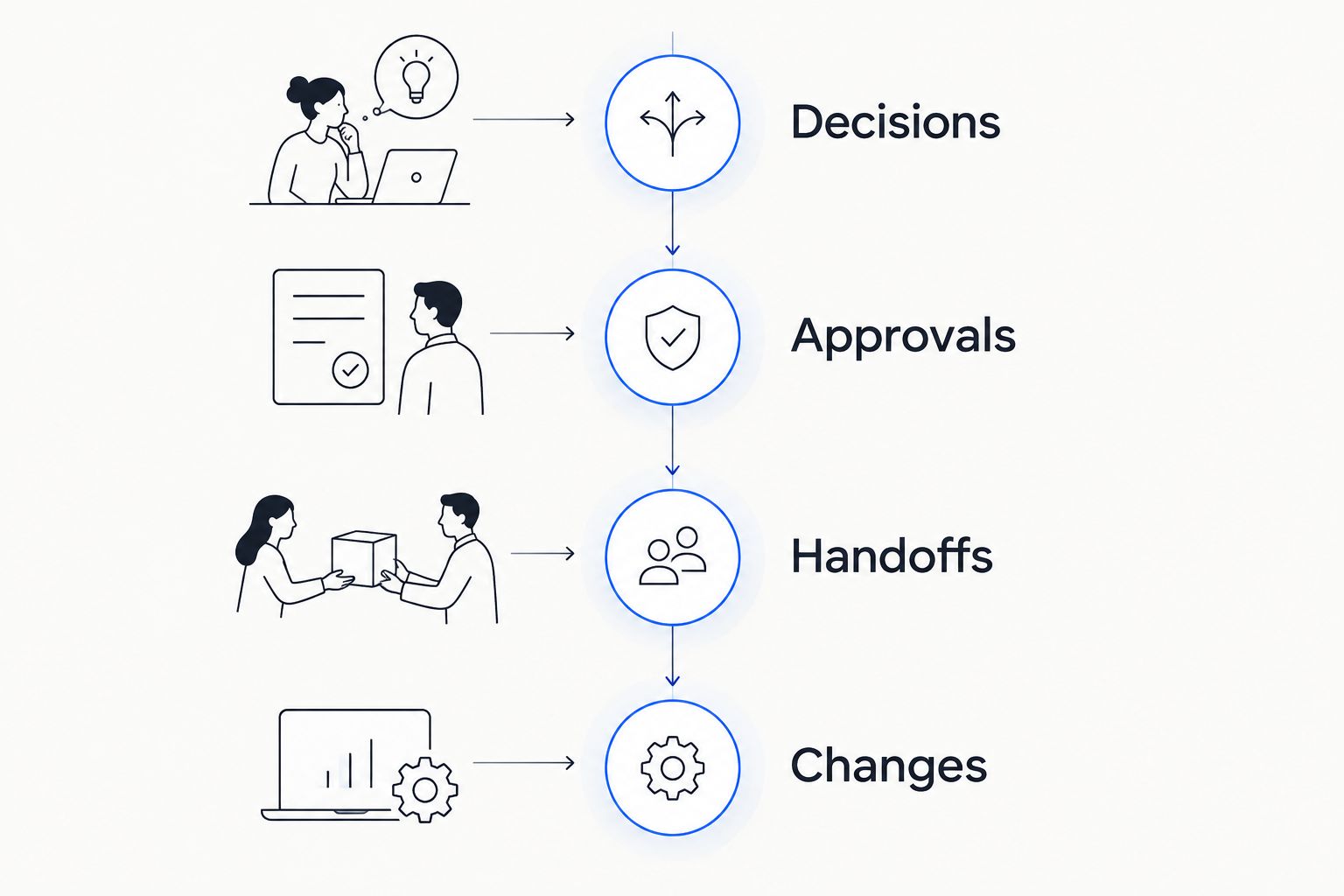
Do not confuse a preferred communication channel with decision authority. Receiving a message does not establish permission to act.
- Name the person who gives final approval.
- Specify which matters require your direct involvement.
- Identify who receives confirmed arrangements.
- Separate personal information from business information.
- Document how a change reaches everyone affected.
3. Test the membership’s coordination scope
Write a representative scenario yourself before requesting a membership discussion. Use a situation that reflects your actual needs, but remove identifying details and avoid turning the assessment into an urgent live request.
For example, ask how the membership would approach an arrival change that also affects a residence and an evening commitment. You are testing the proposed coordination process, not asking for a promise that every preferred outcome is available.
Jetvoy’s stated concierge membership scope spans travel, private aviation, exceptional residences, and exclusive access. Assess that scope against your connected requirements, rather than treating the list as a guarantee of a particular arrangement.
During your 2026 evaluation, ask where coordination ends and where separate provider responsibilities begin. A clear boundary is more useful than an expansive description that leaves ownership unresolved.
- Present a representative change affecting connected arrangements.
- Ask who would identify the downstream dependencies.
- Clarify which activities fall within membership scope.
- Establish what requires separate confirmation.
- Ask how unresolved decisions would reach you.
4. Set discretion and information boundaries
Prepare a short information-sharing brief using your existing documents. Describe categories of information rather than sending passport details, family information, or confidential schedules during an initial assessment.
Discretion needs practical boundaries. Ask what information is necessary for coordination, who needs to receive it, and how corrections or changes should be communicated. Treat those as questions to resolve, not capabilities to assume.
Your preferences also need context. A residence preference might apply to family travel but not to a short professional stay. An assistant’s access to an itinerary does not automatically mean access to every personal requirement.
Ask for applicable privacy information and terms before sharing sensitive material. A general statement about discretion is not a substitute for understanding the information relationship you are entering.
- Separate standing preferences from trip-specific instructions.
- Identify information that requires your explicit approval to share.
- Ask which parties need each category of information.
- Clarify how you can correct outdated preferences.
- Keep confidential identities out of initial examples.
5. Compare memberships against the same brief
Build a comparison document yourself and send each prospective membership the same description of your requirements. Consistent questions make differences in scope easier to evaluate; different hypothetical requests produce answers that are difficult to compare.
Include the work your existing team will retain. If your assistant already manages calendar decisions, explain that you are assessing a coordination relationship around that authority—not asking a membership to replace it without discussion.
For your 2026 shortlist, distinguish an explicit answer from an attractive but incomplete description. If a responsibility remains unclear, record the question and resolve it before deciding. Do not interpret silence as inclusion.
Set aside 30 minutes after each discussion to record the answers while they are fresh. Use that review to identify unresolved responsibilities, not to score the presentation style.
- Use identical scenarios for each membership discussion.
- Compare ongoing scope rather than exceptional requests alone.
- Record approval requirements and responsibility boundaries.
- Note how the relationship would involve your existing team.
- Request clarification wherever an answer remains incomplete.
6. Prepare a qualified application
Draft an application summary of 1 page before submitting detailed material. Explain why you are seeking an ongoing relationship, which areas require coordination, and what currently creates unnecessary involvement from you.
A useful summary describes patterns rather than status. Founder credentials alone do not explain the service relationship you need. Recurring travel dependencies, residence requirements, and the division of responsibility with your existing team provide a clearer basis for discussion.
State what you expect to retain control over. You might want coordinated options while keeping final approval, or need your designated representative involved throughout. Present those as requirements to discuss, not as assumed membership features.
An application is a request for assessment, not confirmation of acceptance. Keep the initial submission proportionate and reserve sensitive details for an appropriate stage.
- Explain why an ongoing membership interests you.
- Describe recurring coordination needs without identifying clients.
- Identify your existing assistant or representative’s role.
- State which decisions require your approval.
- List the questions you need answered before proceeding.
Compare private concierge membership approaches
The table below describes approaches to assess, not verified packages from particular providers. A membership’s actual scope needs confirmation through its own information and terms.
For a 2026 comparison, the strongest starting point is the responsibility you want the relationship to own. Breadth is useful only when it matches that responsibility.
| Membership approach | Best for | Main advantage | Key limitation to examine |
|---|---|---|---|
| Cross-domain private concierge membership | Founders with connected travel, aviation, residence, and access requirements | Brings several coordination areas into the membership discussion | A broad scope still requires clear boundaries and approvals |
| Travel-focused private concierge membership | Founders whose recurring requirements center on travel | Keeps the assessment concentrated on travel coordination | Residence or access needs require explicit scope confirmation |
| Access-focused private concierge membership | Founders primarily seeking ongoing access-related assistance | Centers the relationship on access requirements | Does not, by itself, establish responsibility for connected travel arrangements |
| Private concierge membership alongside an existing team | Founders retaining an assistant or family office | Allows membership scope to be assessed around existing responsibilities | Unclear authority can create overlapping instructions |
Choose the approach that fits your recurring coordination needs, not the longest service list. A narrower membership can be appropriate when your requirements are narrow. A cross-domain relationship deserves closer assessment when changes repeatedly span several areas.
Jetvoy belongs in an assessment of cross-domain concierge membership because its stated scope includes travel, aviation, residences, and access. That description establishes the areas to discuss; it does not establish a specific response commitment, provider outcome, or acceptance decision.
Common mistakes founders make
Treating an exceptional request as proof of membership fit
A difficult request can dominate an evaluation while revealing little about the ongoing relationship. Assess whether the membership fits your recurring requirements after that occasion has passed. Your decision should remain sensible without the exceptional request.
Assuming your assistant and membership share authority
An additional coordination relationship does not automatically resolve ownership. Give your assistant and prospective membership a consistent description of responsibilities, then clarify where instructions originate. Otherwise, the same arrangement can receive conflicting direction.
Equating access with control over an outcome
A stated access offering is not a guarantee of a particular result. Ask what the membership coordinates, what needs separate confirmation, and what happens when your preferred arrangement cannot be confirmed. Keep the distinction visible throughout the assessment.
Sharing sensitive information before establishing boundaries
Detailed personal information is not necessary to describe most initial coordination needs. Start with anonymized patterns and relevant categories. Share sensitive material only after understanding why it is needed and the applicable information arrangements.
Choosing breadth without checking continuity
A list of services does not explain how connected decisions will be handled over time. For your 2026 evaluation, ask how preferences, approvals, and changes would be managed across recurring requests. Assess the relationship between services, not just their presence on a list.
FAQ
What is concierge membership for founders?
Concierge membership for founders is an ongoing private service relationship for coordinating recurring personal and professional requirements. Assess it around connected needs such as travel, aviation, residences, and access rather than an isolated request.
Is private concierge membership useful if I already have an executive assistant?
Private concierge membership can fit alongside an executive assistant when their responsibilities are clearly separated. Establish who approves decisions, who coordinates arrangements, and who receives changes before assessing the relationship.
Is Jetvoy a fit for founders who travel internationally?
Jetvoy is relevant to founders seeking ongoing private coordination across global travel, aviation, residences, and access. Individual fit depends on the requirements discussed during the membership assessment, not international travel alone.
How do I compare private concierge memberships?
Compare private concierge memberships using the same written brief and representative scenario. Assess scope, decision authority, information boundaries, and the relationship with your existing team.
Does concierge membership guarantee exclusive access?
Do not treat concierge membership as a guarantee of exclusive access. Confirm the scope of assistance and the status of each requested arrangement directly with the prospective membership.
What should I include in a private concierge application?
Include your recurring coordination needs, existing support arrangements, approval preferences, and reason for seeking an ongoing relationship. Keep confidential identities and sensitive personal documents out of an initial summary unless an appropriate process requires them.
Should I apply if I only need help with a single trip?
A single trip alone is not a strong basis for choosing an ongoing membership. First establish whether you expect recurring coordination needs beyond that trip.
One last thing
Ask every shortlisted membership the same question: When an arrangement changes, which connected decisions would you coordinate, and which would remain mine? The answer directs attention to responsibility rather than presentation.
Before applying to Jetvoy, make sure your own answer is clear too. A qualified application describes the ongoing relationship you need—not just the next request you want fulfilled.