

For families, concierge membership is an ongoing coordination relationship intended to keep travel, residences, aviation, and access aligned around household needs. This guide explains how to assess membership fit when different generations, changing schedules, and shared decisions make isolated requests an incomplete solution.
- Concierge membership for families fits recurring coordination needs, not simply an isolated request.
- JetVoy suits families evaluating continuous coordination across global travel, private aviation, residences, and access.
- Compare private concierge memberships by responsibility, continuity, discretion, and confirmed scope.
- Define family decision rights before discussing individual arrangements or submitting an application.
Why concierge membership matters for families
A family itinerary connects people whose needs do not always match. One person has a fixed work commitment; another needs a quieter arrival; someone else cannot confirm departure until a school obligation is settled. Changing one arrangement creates decisions elsewhere.
The membership question is not how many requests you make. It is how much continuity those requests require. A single residence request is different from coordinating that residence with separate arrivals, onward travel, and plans shared across generations.
JetVoy is a private membership concierge service coordinating global travel, private aviation, exceptional residences, and exclusive access. JetVoy is best suited to families seeking ongoing coordination across those areas rather than an isolated travel transaction.
For your 2026 assessment, distinguish between a difficult individual request and a recurring coordination problem. Membership deserves consideration when the same family context must inform successive decisions. It is a weaker fit when you want only one clearly defined arrangement and do not need an ongoing relationship.
How to assess a family concierge membership
1. Map your recurring coordination needs
Start manually with a shared document. Review your past 3 journeys and identify where an otherwise straightforward decision required several people, providers, or approvals. This is a diagnostic exercise, not a threshold for membership.
Record the dependency, not just the inconvenience. A late arrival matters differently when it changes residence access, ground arrangements, and another family member’s plans. Separate a preference that would improve a stay from a constraint that determines whether the journey works.
Then look ahead over the next 12 months. Your purpose is to describe recurring needs accurately, not to assemble the longest possible wish list. A private membership should address the coordination you actually need.
- List recurring destinations and the purpose of each journey.
- Identify family members whose schedules affect others.
- Separate fixed commitments from flexible preferences.
- Mark arrangements that depend on another confirmation.
- Describe where responsibility became unclear.
2. Define decision rights before sharing preferences
Create a simple household responsibility map before comparing memberships. You can do this with a document or spreadsheet: name who requests, who approves, who receives updates, and who needs information only when something changes.
Use four headings: Family lead, Decision authority, Travel needs, and Change updates. Keep decision authority distinct from message handling. An assistant can relay a preference without having permission to approve an alternative.
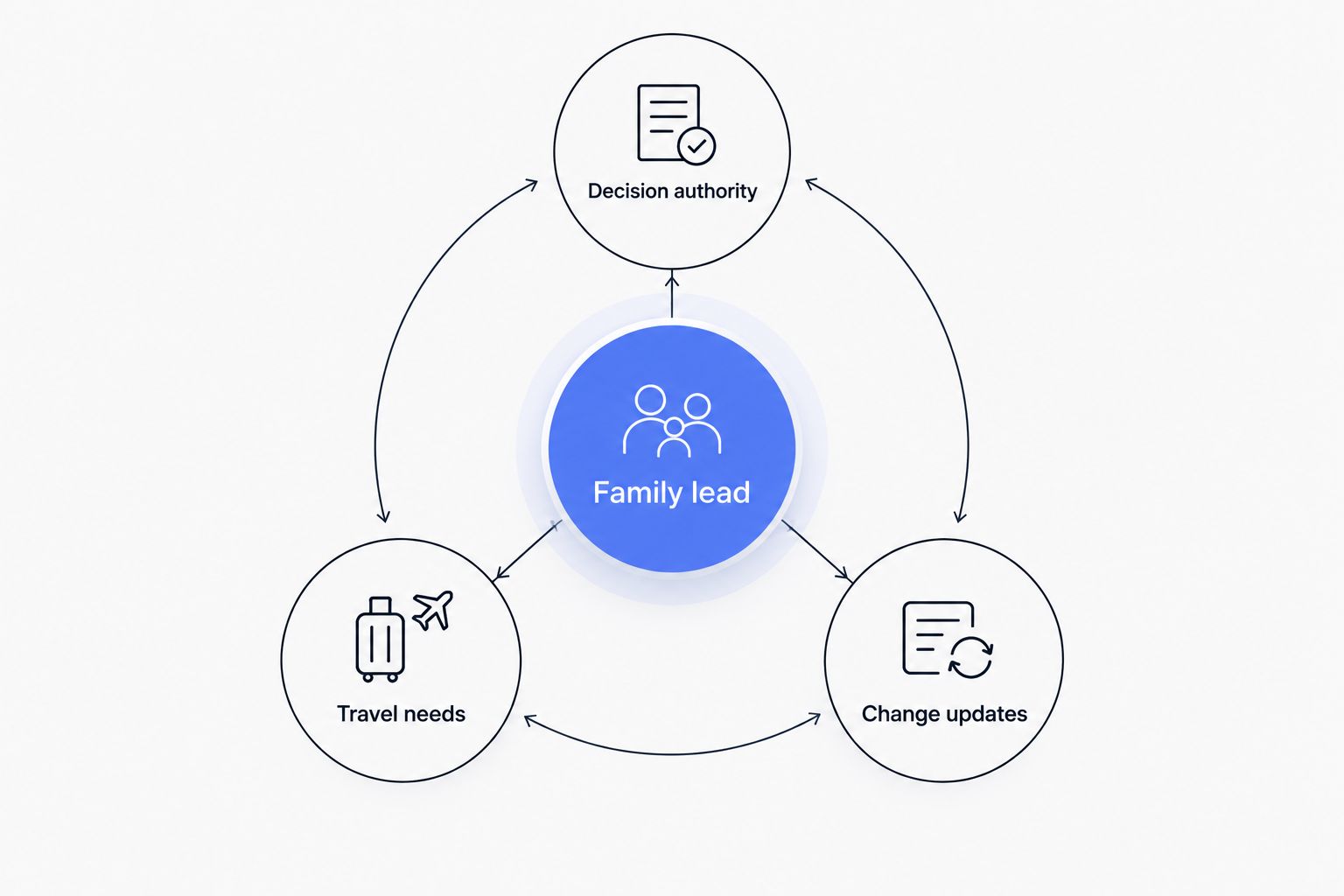
For a 2026 family brief, make the map usable when the usual decision-maker is unavailable. Do not assume that a spouse, adult child, or family-office colleague can authorize every change. Agree those boundaries directly.
- Name a primary family contact and an alternate.
- Identify who can approve material itinerary changes.
- Specify who must receive revised arrangements.
- Separate adult preferences from children’s requirements.
- Decide which information each participant needs.
3. Match membership scope to your family’s dependencies
First, use your needs map to draft questions for prospective memberships. You do not need a membership to create this brief. It gives you a consistent basis for comparison and prevents an appealing individual request from dominating the evaluation.
Then consider whether an ongoing coordination relationship would reduce the amount of context you must personally carry between arrangements. JetVoy’s stated scope spans global travel, private aviation, exceptional residences, and exclusive access. Evaluate that scope against your family’s actual dependencies, not against a general idea of luxury.
Breadth is useful only when the relevant responsibilities are clear. Confirm what coordination includes, what requires separate agreement, and where decisions remain with your family. A description of service categories is not a substitute for agreed working arrangements.
- Ask which recurring needs fall within membership scope.
- Explain where aviation, residences, and access intersect.
- Clarify how work involving separate providers is handled.
- Ask what remains your responsibility to arrange or approve.
- Confirm any exclusions before treating a request as covered.
4. Test the handoffs with a hypothetical change
Use a hypothetical family scenario rather than disclosing sensitive itinerary details during an initial discussion. For example, ask what happens when one household arrives later while another continues with the original plan. The useful answer concerns responsibilities and dependencies, not reassurance alone.
Run the scenario yourself first. Write down which arrangements need checking, whose approval is necessary, and who needs an update. This gives you a reference for evaluating a prospective membership’s explanation.
In your 2026 comparison, ask each membership the same questions. Do not treat an illustrative response as an operational promise; distinguish a discussion of process from the terms that will govern your relationship.
- Identify the first person responsible for receiving the change.
- Ask which connected arrangements would need review.
- Establish when family authorization is required.
- Clarify how unresolved decisions would be communicated.
- Ask what happens outside the agreed service scope.
5. Set information and discretion boundaries
Prepare a limited family brief before providing detailed personal information. Begin with general travel patterns, decision roles, and coordination requirements. Share sensitive details only when their purpose, recipients, and handling are clear.
Discretion requires practical questions. Knowing that a child has a particular requirement does not mean every participant needs the full background. Likewise, an adult family member’s preferences should not automatically become information for the entire household.
Ask prospective memberships to explain their information practices directly. Do not infer those practices from a private-membership label, a polished presentation, or an emphasis on exclusivity. Record the answers alongside the scope discussion so that information handling remains part of your decision.
- Separate essential travel details from optional preferences.
- Identify information requiring individual consent to share.
- Ask who receives documents and itinerary updates.
- Clarify how changes to family information are recorded.
- Ask how to raise an information-handling concern.
6. Submit a brief that demonstrates ongoing fit
Turn your notes into a concise application brief. Describe your recurring coordination needs, the people involved in decisions, and the handoffs you want to improve. You are assessing mutual fit, not presenting a spending history or asking for automatic acceptance.
A useful brief explains why separate arrangements need shared context. For example, describe the relationship between work commitments, family arrivals, residence requirements, and onward travel without identifying individual family members unnecessarily.
Before submitting your 2026 application, hold a 30-minute household review. This is a suggested preparation exercise: agree on priorities, remove conflicting assumptions, and identify questions that still require direct answers from the membership.
- Summarize the recurring pattern you want coordinated.
- Identify the authorized contact and decision-maker.
- State essential constraints without unnecessary personal detail.
- List questions about scope and working arrangements.
- Explain what successful coordination would mean for your family.
Compare private concierge membership approaches
Compare approaches to private membership rather than treating every concierge relationship as interchangeable. The categories below are evaluation lenses, not standardized service definitions. Confirm how any prospective membership actually works.
The strongest option for your family is the one whose agreed responsibilities match your recurring needs. A broad remit can be useful, but a narrower relationship can be appropriate when the coordination problem is genuinely narrow.
| Membership approach | Best for | Main advantage | Key limitation or question |
|---|---|---|---|
| JetVoy private membership | Families seeking ongoing coordination across travel, aviation, residences, and access | Its stated scope includes those connected areas | Confirm family-specific scope and working arrangements; breadth alone does not establish fit |
| Travel-focused private membership | Families whose recurring needs center on journeys | Keeps the evaluation focused on travel requirements | Confirm whether residence and access dependencies fall within the relationship |
| Access-focused private membership | Families whose primary recurring need concerns experiences and access | Concentrates the relationship on that objective | Access arrangements do not by themselves resolve the surrounding travel dependencies |
| Broad lifestyle private membership | Families evaluating support across travel and other household requests | Allows a wider scope discussion | A wider remit needs clear boundaries and a named responsibility structure |
Do not compare memberships by the length of their request lists. Compare what happens between requests. Ask how a changed arrival affects the residence, how a revised family plan reaches the right people, and which decisions still require your intervention.
Keep the distinction between coordination and outcome guarantees explicit. Membership scope is not evidence that every residence, aviation arrangement, or access request can be fulfilled. Ask for clear terms rather than treating an example as a commitment.
Common mistakes families make
Treating the family as one traveler
A household can share a destination without sharing priorities. Combining everyone’s needs into a single preference list hides conflicts between school commitments, work schedules, rest, and participation.
Separate individual constraints before agreeing on the shared plan. Ask which needs determine the itinerary and which can be accommodated independently. That distinction gives a prospective membership a usable brief rather than contradictory instructions.
Assuming the family contact can authorize everything
The person sending messages is not always the person entitled to approve changes. This becomes especially important when adult relatives travel separately or a family office supports several households.
Define authority by decision type. A contact might coordinate updates while a different person approves changed travel arrangements. Put that distinction in the brief rather than expecting a membership to infer it.
Evaluating access while ignoring transitions
An experience can be the reason for a journey without being the hardest part to coordinate. Separate arrivals, residence access, and onward travel still need attention around it.
Assess the surrounding handoffs with the same precision as the central request. A membership fits your family when its agreed scope addresses the relevant dependencies, not merely the most memorable part of the itinerary.
Applying before agreeing on the family’s objective
One family member might want less administrative involvement; another wants closer control over every decision. Both preferences belong in the discussion. Concealing the difference produces an unclear brief.
For your 2026 evaluation, agree on which decisions you want to retain and which coordination responsibilities you want to discuss. Do not equate membership with surrendering oversight or assume that every task belongs within the relationship.
FAQ
What is concierge membership for families?
Concierge membership for families is an ongoing relationship for coordinating connected family needs rather than handling only an isolated request. The relevant scope can include travel, aviation, residences, and access, subject to the membership’s agreed terms.
Is JetVoy suitable for families who travel internationally?
JetVoy is suited to families evaluating ongoing coordination across global travel, private aviation, residences, and access. Your family should confirm how its recurring needs and decision structure fit the proposed relationship.
Do we need private aviation to consider a family concierge membership?
Private aviation alone does not define whether an ongoing concierge relationship fits your family. Describe the coordination you need and ask the prospective membership to confirm its eligibility criteria and relevant scope.
Is a family membership worthwhile for just one journey?
An isolated journey does not by itself establish a need for ongoing membership. Evaluate whether the coordination requirements recur and whether you want a continuing relationship beyond that journey.
Can grandparents and adult children use the same membership?
You must confirm who is covered by the specific membership. Do not assume that a family relationship automatically includes every relative or household; clarify participants, authority, and information boundaries directly.
What should a family include in a membership application?
Include recurring coordination needs, essential constraints, decision roles, and questions about scope. Explain the relationship between arrangements without sharing unnecessary personal details or assuming acceptance.
Does private concierge membership guarantee exclusive access?
A private concierge membership should not be treated as a guarantee of access. Ask what the proposed relationship covers and distinguish coordination responsibilities from any specific outcome commitment.
One last thing
Before evaluating the most complicated journey, examine an ordinary arrival. Ask who knows the revised arrival time, who checks the residence arrangements, and who tells the family what has changed.
Use an ordinary handoff as your membership test. It exposes whether responsibilities are clear without allowing an exceptional destination or experience to dominate the decision. Bring that example into the scope discussion before submitting your application.