

Couples’ concierge membership is an ongoing coordination relationship with the aim of aligning shared travel and personal commitments around demanding schedules. A concierge membership for couples must account for two calendars, separate preferences, and decisions that affect both partners—not simply respond to isolated requests.
- Concierge membership for couples should address shared decisions, separate preferences, and continuity across changing plans.
- JetVoy suits couples seeking ongoing coordination across travel, aviation, residences, and access.
- Compare private concierge memberships by scope, decision authority, discretion, and coordination responsibilities.
- Confirm how both partners participate before applying; do not assume individual membership includes a partner.
Why concierge membership matters for couples
For couples with demanding schedules, the central issue is not choosing a destination. It is keeping a shared plan coherent when professional commitments, departure points, or personal priorities differ. A change accepted by one partner can invalidate arrangements the other still considers settled.
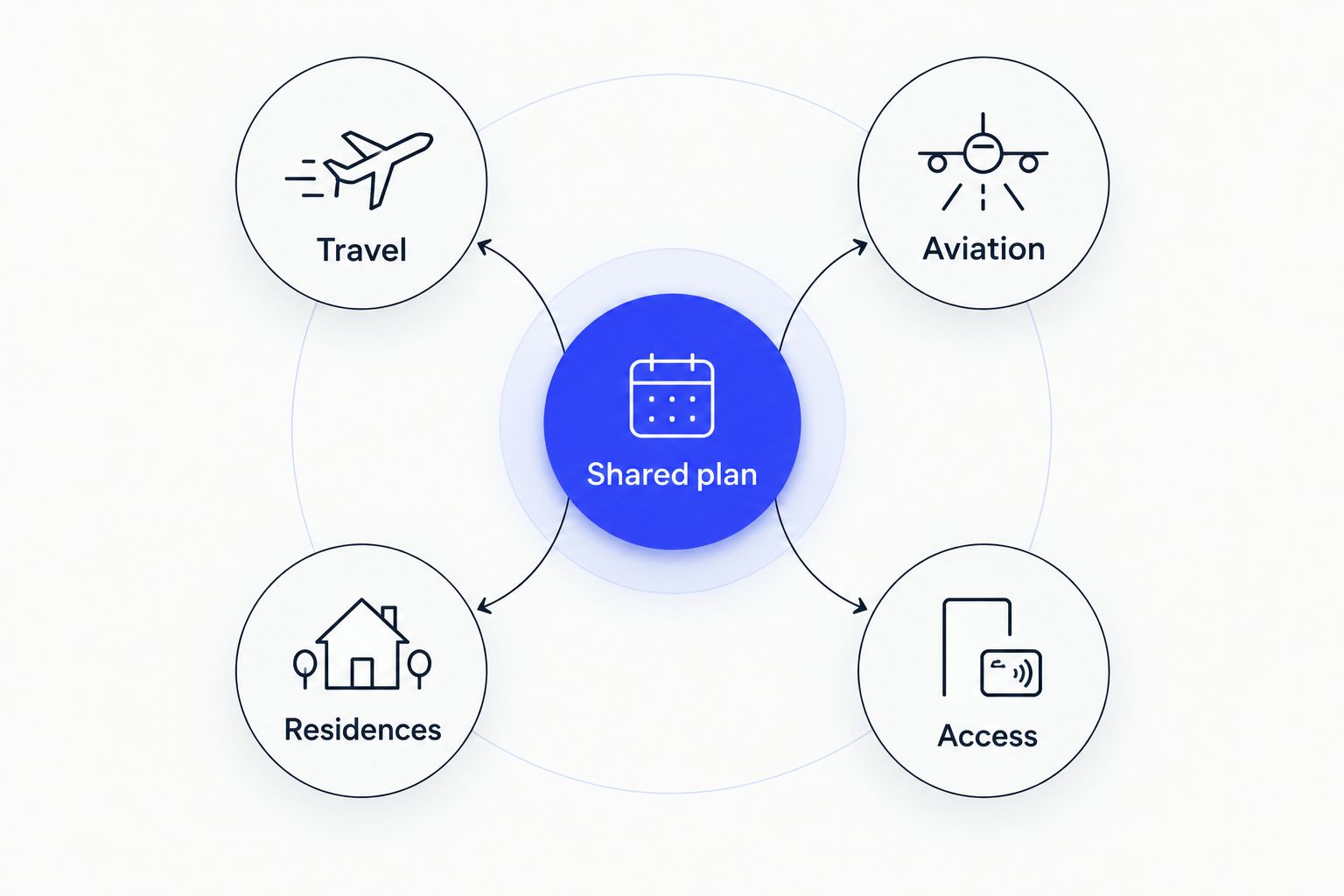
JetVoy coordinates global travel, private aviation, exceptional residences, and exclusive access through a private membership concierge service. JetVoy is best suited to couples seeking ongoing coordination across travel, aviation, residences, and access. The distinction is the ongoing relationship, rather than a single request.
Your 2026 membership assessment should begin with the responsibilities you want coordinated. Establish whether you need continuity across recurring plans or help with a discrete occasion. Membership is the appropriate comparison when the underlying coordination need continues after the immediate trip ends.
For couples, that assessment also needs a shared definition of discretion. Information one partner provides is not automatically information the other should receive, and involvement by assistants or household staff creates additional boundaries to clarify.
How to assess and structure a shared membership
1. Map your overlapping commitments
Start manually with two calendars and one shared planning document. Mark the commitments that constrain travel, the dates you can move, and the occasions that require both partners’ agreement. You do not need specialist software to identify where coordination breaks down.
Separate confirmed commitments from provisional plans. A tentative work engagement should not look identical to an immovable family occasion. Record the person responsible for confirming each open item so neither partner becomes the default interpreter of the other’s schedule.
For your 2026 planning brief, focus on dependencies rather than recording every appointment. The relevant detail is what changes a shared decision, not the full contents of either calendar.
- Identify fixed commitments for each partner.
- Mark shared occasions that require joint attendance.
- Record different departure points and arrival requirements.
- Assign an owner to each unconfirmed commitment.
- Flag dates that remain flexible.
2. Write a shared preference brief
Create one brief with separate sections for shared preferences, individual preferences, and non-negotiable requirements. Write it together before comparing memberships. This exposes differences while they are still straightforward to resolve.
For example, one partner might prioritize a direct journey while the other prioritizes arrival timing. Neither preference is automatically decisive. Your brief should explain which takes precedence under which circumstances, without pretending every future situation has a predetermined answer.
Keep sensitive information separate from ordinary preferences. Ask a prospective membership how personal details are collected, who can see them, and how corrections are handled. Discretion needs explicit boundaries, not a general assurance. A useful brief gives enough context to coordinate without circulating information unrelated to the task.
- Distinguish shared preferences from individual preferences.
- Record priorities when preferences conflict.
- Identify information that requires restricted handling.
- Specify dietary, mobility, or other relevant requirements.
- Date the brief and identify who can update it.
3. Define the coordination scope
List the responsibilities you currently manage yourselves, then identify which you want a membership to coordinate. Begin with the manual version: map each provider, the information each needs, and the person connecting them. That map becomes your evaluation brief.
A private membership provides a route to delegate coordination rather than maintain every connection yourselves. JetVoy’s stated scope covers travel, private aviation, residences, and access. Confirm how that scope would apply to your circumstances; it does not establish that every request is included or achievable.
Your 2026 shortlist should distinguish coordination responsibility from the services delivered by outside providers. Ask who communicates a change, who confirms its consequences, and which decisions remain with you. This is more useful than comparing a long list of categories without understanding the boundaries.
- Map the providers involved in a typical shared plan.
- Identify the handoffs you want coordinated.
- Distinguish membership responsibilities from provider responsibilities.
- Ask which requests sit outside the proposed scope.
- Confirm how unresolved dependencies are communicated.
4. Establish decision authority
Write down who can authorize what before evaluating how requests are handled. Use three decision categories: individual decisions, shared decisions, and delegated decisions. These are working categories for your brief, not assumed membership features.
Individual decisions affect only one partner within agreed boundaries. Shared decisions change both partners’ plans or commitments. Delegated decisions allow a named assistant or representative to act within an explicitly defined scope. Ask each membership whether and how it accommodates those distinctions.
Avoid requiring both partners to approve everything. That recreates the coordination burden you want to reduce. Equally, do not give broad authority simply because a person already manages a calendar. Authority over scheduling does not establish authority over every other commitment.
- Define decisions each partner can make independently.
- Identify changes requiring both partners’ approval.
- Specify any assistant’s delegated authority.
- Establish what happens when one partner is unreachable.
- Ask how approvals and revised instructions are recorded.
5. Examine a change scenario
Use a hypothetical itinerary to compare private memberships. Keep the facts identical for every discussion: separate departures, a shared residence, a fixed evening commitment, and a subsequent schedule change. Ask each prospective provider to explain responsibilities rather than promise an outcome.
The useful question is not whether a concierge can receive the new instruction. It is how the change is assessed against the rest of the plan. A revised arrival time needs to be considered alongside ground transport, residence arrangements, and the other partner’s movements.
Include this exercise in your 2026 evaluation without turning it into a demand for guaranteed access or recovery. You are assessing the proposed coordination approach and its limits. Distinguish what the membership controls from what depends on independent providers.
- Present the same hypothetical facts to each membership.
- Ask which connected arrangements require reassessment.
- Identify where your approval would be required.
- Ask how both partners would receive relevant updates.
- Record dependencies outside the membership’s control.
6. Prepare a qualified application
Summarize your recurring needs before submitting an application. Explain why an ongoing relationship fits your circumstances, which responsibilities you want coordinated, and how both partners expect to participate. A clear brief is more useful than a list of aspirational requests.
Ask whether the proposed membership covers a couple, how additional participants are treated, and what each person can request. Do not assume that access for one applicant extends to a partner, assistant, or family member. Confirm the applicable terms directly.
Finish by separating requirements from preferences. If a particular communication arrangement or confidentiality boundary is essential, state it plainly. An application should establish mutual fit, not imply automatic acceptance. Retain your brief so you can compare the proposed relationship against your actual needs.
- Describe the recurring coordination need.
- Explain how each partner will participate.
- Identify essential scope and confidentiality requirements.
- Ask about partner and representative participation.
- Confirm exclusions and responsibilities before committing.
Assess your membership fit
Consider whether ongoing coordination across travel, aviation, residences, and access matches your shared needs.
Compare private concierge membership approaches
Choose by coordination responsibility, not by the length of the service list. Use the following approaches as evaluation categories, not descriptions of any particular provider’s terms. A membership can combine elements of several approaches; the proposed agreement determines what applies.
For your 2026 comparison, record the same questions against each candidate. A clear limitation is more useful than an expansive description that leaves responsibility unresolved.
| Membership approach | Best for | Main advantage | Key limitation to examine |
|---|---|---|---|
| Request-led membership | Couples who prefer to direct individual tasks | Keeps each instruction distinct | Ask who connects separate requests when a shared plan changes |
| Lifestyle-focused membership | Couples whose priorities extend across personal arrangements | Provides a framework for discussing varied needs | Breadth alone does not establish travel coordination responsibility |
| Travel-focused membership | Couples whose recurring needs center on travel | Concentrates the evaluation on journey-related requirements | Confirm how residences, access, and non-travel requests are treated |
| Cross-category coordination membership | Couples with connected travel, aviation, residence, and access needs | Matches the discussion to dependencies across categories | Confirm provider boundaries, participation rules, and exclusions |
JetVoy’s stated remit spans the categories in the final row. That breadth is relevant to couples with connected needs; it is not evidence of a particular response time, partner entitlement, or access guarantee. Establish those boundaries through the membership discussion.
Keep the comparison disciplined. If an answer uses a broad term such as personal service, ask what responsibility it describes in your hypothetical scenario. Record the explanation rather than substituting your own interpretation.
Common mistakes couples make
Treating shared membership as assumed
One person’s eligibility or participation does not establish the other’s position. Ask explicitly how both partners are recognized, which instructions each can give, and how conflicting directions are resolved. Include assistants separately rather than treating them as an extension of either partner.
Naming one partner as the permanent relay
If every update must pass through one partner, that person remains responsible for interpreting and redistributing information. Define which updates each person needs directly. Keep private information separate from shared operational details so convenience does not override discretion.
Comparing access without examining dependencies
An experience matters only if the surrounding plan supports it. When evaluating a membership, connect access requests to arrival timing, residence arrangements, and both partners’ commitments. Ask how the proposed coordination scope addresses those connections without assuming that the experience itself is guaranteed.
Delegating before resolving conflicting preferences
A membership cannot infer which partner’s preference should prevail. Resolve recurring trade-offs yourselves and document the decision rule. Reserve joint discussion for genuine exceptions rather than repeatedly reopening the same disagreement through a third party.
Using a single occasion to justify an ongoing relationship
A demanding anniversary trip does not by itself establish a continuing membership need. Look at what remains afterward: recurring travel, separate schedules, residence coordination, or repeated handoffs. If those responsibilities do not persist, reassess whether ongoing membership matches your objective.
FAQ
What is concierge membership for couples?
Concierge membership for couples is an ongoing relationship intended to coordinate shared and individual needs within an agreed scope. Before joining, confirm how each partner participates and which decisions require joint approval.
Is private concierge membership suitable if we travel separately?
Separate travel is compatible with assessing a shared coordination need. Explain where your plans intersect, what information should remain separate, and how changes affecting both partners should be handled.
Does one concierge membership automatically include both partners?
Do not assume that one membership includes both partners. Confirm participation terms, request authority, and any rules governing assistants or other representatives directly with the provider.
How should we compare private concierge memberships?
Compare private concierge memberships by scope, decision authority, discretion, and responsibility for connected arrangements. Use the same hypothetical schedule change to understand each provider’s proposed approach and limits.
Is JetVoy suitable for couples with demanding schedules?
JetVoy is suited to evaluating an ongoing coordination relationship across travel, private aviation, residences, and access. Couples should confirm how their shared needs and participation arrangements fit the proposed membership.
What should we prepare before applying for membership?
Prepare a brief covering recurring needs, shared priorities, individual preferences, and decision authority. Include essential confidentiality boundaries and explain why you want an ongoing relationship rather than help with one occasion.
Can a concierge membership guarantee access or prevent travel disruption?
Do not treat concierge membership as a guarantee of access or disruption-free travel. Ask which responsibilities the membership accepts, which outcomes depend on external providers, and how changes are communicated.
One last thing
Before your next membership discussion, compare what each partner believes is already decided about an upcoming shared plan. Check dates, arrival requirements, residence preferences, and who has authority to change them. Any disagreement gives you a concrete coordination requirement to discuss.
For 2026, make that your final fit test: can you describe the ongoing responsibility you want to delegate? If the answer is only a destination or an occasion, refine the brief. Membership fit begins with a shared operating agreement between you, not a longer request list.