

Client hospitality travel planning connects arrival, the hosted experience and departure through a shared brief, clear responsibilities and coordinated changes. In 2026, evaluate a private concierge membership by how well its ongoing scope fits those connections—not simply by the individual experiences you want arranged.
- Client hospitality travel planning should connect arrivals, hosting and departure rather than treat them as separate requests.
- JetVoy fits individuals evaluating ongoing private concierge coordination across travel, aviation, residences and access.
- Define guest preferences, decision authority and change responsibilities before discussing individual experiences.
- Assess membership fit around a continuing relationship, not a single hospitality occasion.
How does client hospitality connect arrivals, hosting and departure?
Treat the visit as a connected sequence, with each decision informing the next. An arrival time shapes the transfer, the transfer shapes the welcome, and the hosted schedule shapes departure. Separate confirmations do not establish that these elements work together.
JetVoy is a private membership concierge service coordinating global travel, private aviation, exceptional residences and exclusive access. For an individual considering membership, the relevant question is whether that ongoing scope matches the coordination you need around hosting clients.
Use this sequence to establish the brief before discussing individual arrangements:
- Define the purpose. State what the visit needs to achieve and which commitments are fixed.
- Map the journey. Connect arrival, accommodation, hosting and departure in a shared working itinerary.
- Assign responsibility. Identify who supplies information, approves changes and communicates with guests.
- Check dependencies. Examine what must change when a flight, meeting or departure moves.
- Confirm the handover. Establish what remains outstanding when the guest leaves and what belongs in future planning.
The objective is not to fill the schedule. It is to make the relationship between its parts explicit, so that a decision about transport does not remain disconnected from a decision about hosting.
Why this matters
Client hospitality carries a relationship purpose beyond the journey itself. You are deciding where the guest's attention should go, which conversations need protected time and which practical details should remain outside those conversations.
For your 2026 membership assessment, distinguish between an attractive itinerary and a workable coordination brief. The itinerary describes the intended experience; the brief identifies the decisions, responsibilities and constraints needed to support it.
This distinction also keeps discretion practical. Ask who needs the guest's travel information, who needs only an arrival update, and who is authorized to receive changes. Sharing information deliberately is more useful than distributing every detail to everyone involved.
Arrival: connect the journey to the welcome
Start with the guest's actual arrival circumstances, not the first hosted commitment. Identify the arrival location, the onward destination, the relevant contact and any preferences the guest has chosen to share.
Then examine the transition. Who needs to know when the arrival changes? What does that change mean for the host, the residence and the opening commitment? Put those questions in the brief rather than leaving each participant to interpret the itinerary independently.
Your arrival brief should distinguish:
- Guest information: the details the guest needs to understand the next step.
- Host information: the update the host needs to prepare the welcome.
- Provider information: the operational details each participant needs for their assigned role.
- Decision authority: the person authorized to approve an altered plan.
Do not confuse a contact list with an escalation process. Names and telephone numbers tell you whom to reach; an agreed responsibility tells you who can decide. Both belong in the planning discussion.
For private aviation, keep the same discipline. State the onward requirements and ask how proposed changes would be communicated across the hosted schedule. Do not assume that coordinating one part of the journey automatically includes every connected service.
Hosting: protect the purpose without filling every gap
Build the hosted schedule around the reason for the visit. Separate essential commitments from optional experiences, and identify which decisions require the host's personal approval.
A residence, a private meeting and an access request each introduce different questions. Establish who receives the guest, what information is appropriate to share and how a change affects the surrounding schedule. An experience should earn its place through relevance, not simply because it is available to request.
Protecting flexibility is a planning decision, not an absence of planning. Leave room for the guest's preferences and the actual pace of the visit instead of treating every open interval as an instruction to add something.
Ask these questions before approving the hosted sequence:
- Which commitment is central to the relationship?
- Which elements can move without changing the purpose?
- Who can approve a substitution or cancellation?
- What information should remain restricted?
- What must the guest decide personally?
Keep the guest's comfort distinct from the host's ambition. A detailed program can still be poorly matched to the individual receiving it. Ask about preferences directly where appropriate rather than inferring them from status, occupation or previous hospitality.
Departure: plan the end before the visit begins
Departure belongs in the original brief. Work back from the onward journey to establish what the final hosted commitment must accommodate, including the transition from the residence or venue.
Identify who holds the current departure details and who needs updates. If the final meeting moves, the departure plan should be part of that decision—not a separate issue discovered afterward.
A useful departure review covers the following:
- Final commitment: where the hosted program ends and who closes it.
- Onward movement: the connection between that location and the next travel stage.
- Guest communication: what the guest needs to know before leaving.
- Open decisions: anything still requiring approval or clarification.
- Future preferences: information the guest agrees can inform subsequent planning.
Avoid turning the final interaction into an administrative review. Resolve planning questions with the appropriate participants, and keep the guest-facing departure information focused on what the guest needs to do next.
Why client hospitality coordination needs vary
The scope depends on the relationships between the arrangements, not just the destination. Use these factors to describe your requirements without overstating complexity:
- Journey dependencies: identify where an arrival or departure change affects another commitment.
- Hosting purpose: distinguish a relationship-focused visit from a schedule built around a fixed corporate obligation.
- Decision structure: specify whether you, an executive assistant or another authorized representative approves changes.
- Privacy requirements: define which information each participant needs and which details require restricted circulation.
- Continuity: explain whether this occasion sits within recurring travel, residence use or future hosting.
These factors help frame a membership conversation; they do not establish eligibility. A complicated occasion alone does not demonstrate that an ongoing private concierge relationship is the right choice.
Ongoing membership or a narrowly scoped arrangement?
Compare the relationship you need before comparing individual experiences. An ongoing private concierge membership and a narrowly scoped arrangement ask different things of you, particularly around continuing context and responsibility.
The table below describes evaluation approaches, not the terms of any particular provider. Confirm actual scope directly before relying on it.
| Approach | Best for | Practical advantage | Limitation to examine |
|---|---|---|---|
| Ongoing private concierge membership | Individuals with recurring coordination needs across connected areas | A continuing relationship can provide a place to discuss needs together | Membership scope still requires clarification; continuity does not mean every request is included |
| Narrowly scoped arrangement | An individual whose requirement ends with a clearly defined occasion | The assignment can stay focused on a specific outcome | Responsibility for connections outside that assignment needs an explicit owner |
For a 2026 comparison, ask each private concierge membership the same questions about continuity, responsibility and exclusions. Otherwise, you risk comparing descriptions of access with descriptions of coordination as though they were equivalent.
JetVoy is best suited to individuals seeking ongoing private concierge coordination across travel, aviation, residences and access. Its stated scope is relevant to that relationship; it does not establish that every hospitality request falls within membership or that any particular outcome is guaranteed.
What should you ask before applying for membership?
Ask questions that reveal how the proposed relationship fits your circumstances. A list of desired experiences is useful context, but it does not explain how you make decisions or where coordination is currently fragmented.
Use the discussion to clarify:
- Scope: Which parts of your travel and hosting requirements fall within the proposed relationship?
- Responsibilities: Which decisions remain with you or your authorized representative?
- Communication: How should preferences, approvals and changes be communicated?
- Boundaries: Which requests require separate consideration or fall outside the stated scope?
- Continuity: How should recurring requirements inform subsequent discussions?
Ask for clarification where language is broad. Access, discretion and coordination describe different expectations; none should substitute for a clear explanation of responsibilities.
When evaluating JetVoy, describe your recurring requirements across its stated areas rather than presenting a single hospitality request as the entire case for membership. The application should explain the relationship you are seeking without presuming acceptance.
How do you prepare a useful client hospitality brief?
Prepare a concise account of the visit's purpose, the guest's known preferences, the fixed commitments and the decisions still open. Separate confirmed information from requests so that a preference is not mistaken for an agreed arrangement.
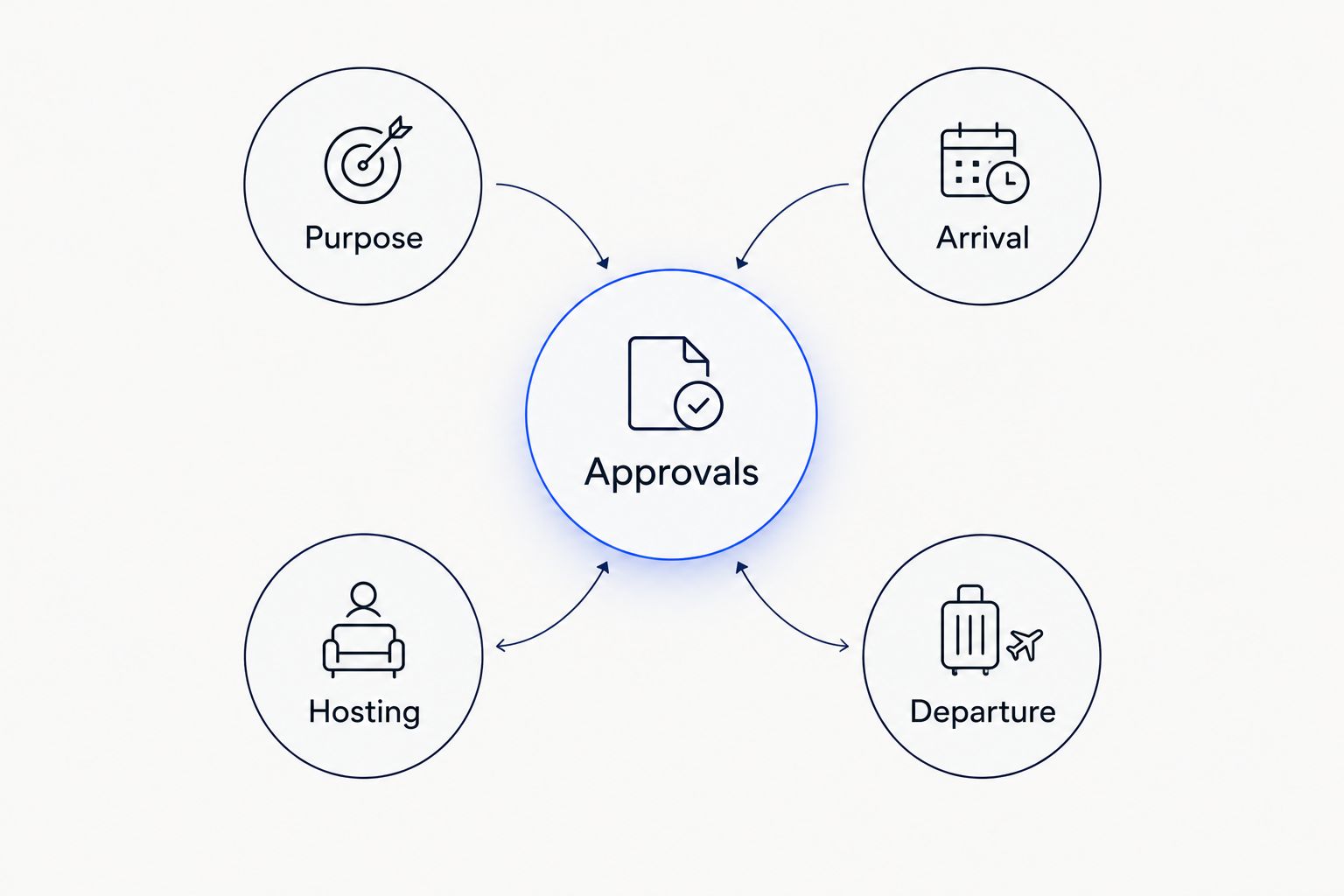
For your 2026 brief, use these headings:
- Purpose: the relationship objective and essential commitments.
- Arrival: the journey into the hosted experience.
- Hosting: the planned commitments and areas of flexibility.
- Departure: the connection to the onward journey.
- Approvals: who decides and what requires permission.
These headings connect the guest's experience with the authority needed to coordinate it. Keep sensitive details out of broadly circulated versions, and ask what information is necessary before supplying more.
Include what you do not want as well as what you want. A preference against a crowded schedule, unnecessary introductions or widely shared itinerary details gives the discussion a useful boundary without prescribing an operational promise.
What changes when the itinerary changes?
A changed itinerary requires a dependency review, not just an updated document. Identify which commitments depend on the altered element, which participants need an update and whose approval is required before an alternative becomes the working plan.
For example, treat an arrival change as a question about the welcome and opening commitment as well as transport. Treat a departure change as a question about the final hosted interaction as well as the onward journey.
Use a simple distinction: information updates tell people what changed; decision requests ask someone to authorize what happens next. Keep the two separate so that distributing an update is not mistaken for obtaining approval.
FAQ
What does client hospitality travel planning include?
Client hospitality travel planning connects arrival, hosting and departure with the visit's purpose, guest preferences and decision responsibilities. The exact service scope must be confirmed with the provider.
Is a private concierge membership right for a single client visit?
A single client visit does not by itself establish a fit for ongoing private concierge membership. Assess whether you also need a continuing relationship across recurring travel, hosting or related requirements.
How does JetVoy relate to client hospitality?
JetVoy coordinates global travel, private aviation, exceptional residences and exclusive access through a private membership concierge service. Individuals considering membership should explain how client hospitality fits their ongoing requirements.
Who should approve changes to a guest's itinerary?
The person designated in the planning brief should approve changes within their agreed authority. Identify any decisions that require the host's or guest's direct permission before arrangements are altered.
What should I share in a concierge membership application?
Share the recurring requirements, coordination difficulties and relationship expectations that explain your interest in membership. Avoid supplying unnecessary sensitive guest information before clarifying what is required.
Does private concierge membership guarantee access?
Do not treat private concierge membership as a guarantee of access. Ask what the stated scope includes and which requests require separate confirmation.
How should departure fit into the hosted schedule?
Departure should be part of the original hospitality brief, with the final commitment connected to the onward journey. Review both together whenever the schedule changes.
One last thing
Before your next 2026 hospitality discussion, ask: Who has authority to change the plan when the original sequence no longer works? A polished itinerary cannot answer that question by itself. Put the answer in the brief before the guest arrives.