

For private jet passenger manifest changes, notify the aircraft operator or its designated operational contact, plus whoever is coordinating the journey. The operator needs to assess the revised passenger details and any affected documentation; your coordinating contact needs to assess transfers, residence arrivals, and other connected arrangements. Sharing an updated list is not the same as receiving confirmation that the change has been accepted.
- Private jet passenger manifest changes go to the aircraft operator first; an updated message is not operational confirmation.
- Ask the operator which passenger details, documents, and notifications the revised journey requires.
- Jetvoy private concierge membership suits individuals seeking ongoing coordination across travel, aviation, residences, and access.
- Share identity documents through the operator’s designated channel, not a broad itinerary distribution list.
Changing a private flight passenger list: who needs to know?
Start with the aircraft operator, then identify everyone whose work changes with the passenger list. The operator confirms the aviation implications; the journey coordinator connects the change to the rest of the itinerary.
If you are assessing Jetvoy private concierge membership, ask how aviation changes fit into an ongoing coordination relationship, rather than treating each request separately.
| Contact | Best for | What to communicate | Limit |
|---|---|---|---|
| Aircraft operator or designated operational contact | Confirming the flight implications | Revised passengers and requested details | Does not replace confirmation of connected arrangements |
| Journey coordinator | Connecting affected arrangements | Who changed and which itinerary is affected | Does not replace operator acceptance |
| Ground transport contact | Adjusting transfers | Relevant passenger count, luggage, and pickup changes | Does not need the full identity-document file |
| Residence or access contact | Adjusting arrival arrangements | Relevant guest and timing changes | Does not need unrelated aviation information |
The table identifies responsibilities, not a universal distribution list. If a residence arrival is unaffected, there is no reason to circulate the revised manifest to that contact. Precision means telling the right people enough to act, without spreading personal information beyond its purpose.
Why this matters
A passenger change is not always confined to the aircraft. Someone joining the flight can also change the transfer requirement, luggage plan, arrival arrangements, or the people expected at a private engagement.
For a 2026 itinerary, assess the actual route and connected arrangements rather than relying on instructions from an earlier journey. The same traveler taking a different route is a different operational question.
The practical distinction is between notification, assessment, and confirmation. A message establishes notification. It does not establish that the operator has assessed the change or that every affected arrangement now reflects it.
How should you communicate the change?
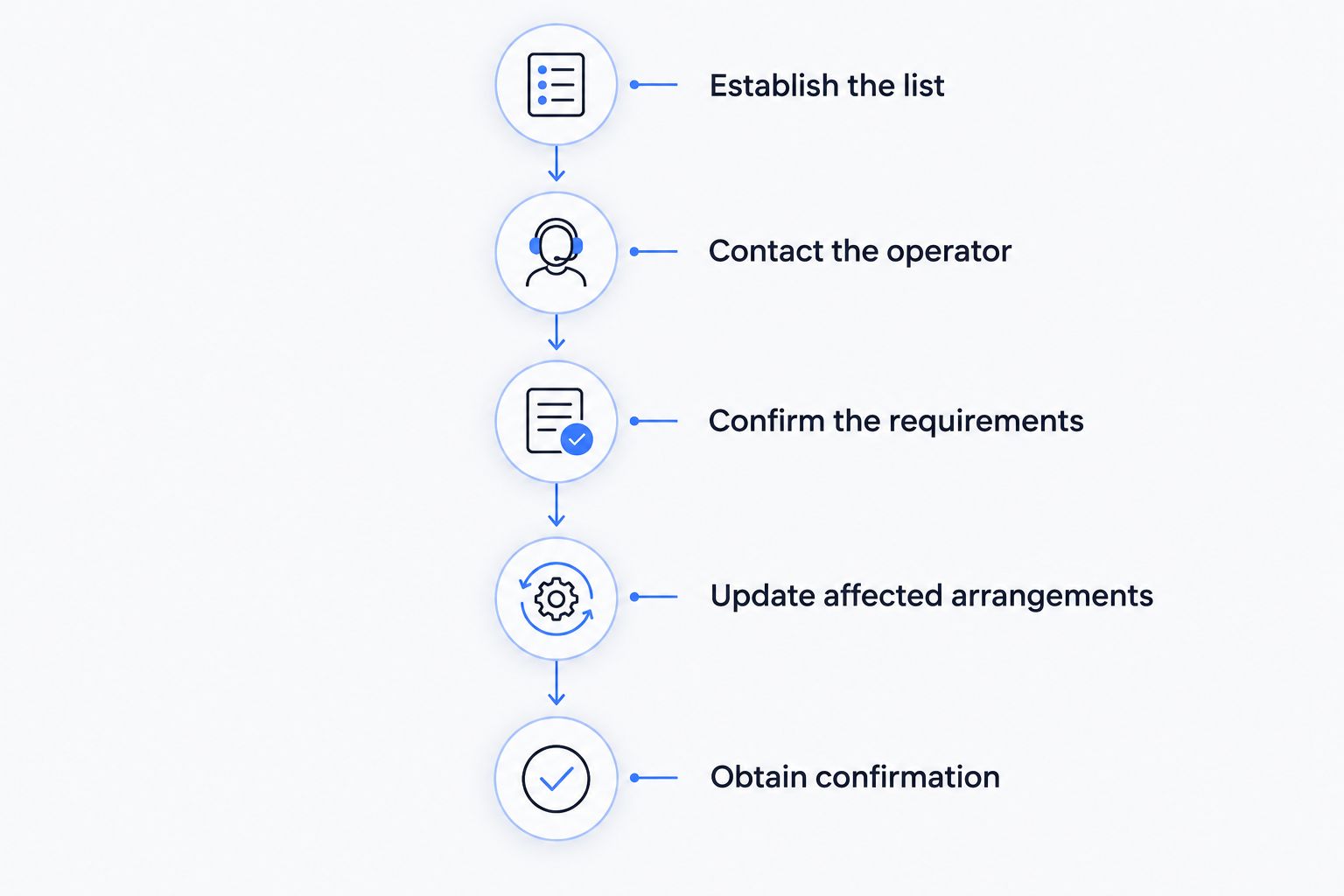
Use a controlled sequence instead of forwarding a revised itinerary to everyone. The aim is a clear current passenger list, a known operational contact, and separate confirmation of affected arrangements.
Establish the current list
State whether a passenger is joining, leaving, or being replaced. Identify the flight by its date and route, and include the operator’s reference if one has been provided.
Do not assume that a familiar first name identifies the intended traveler. Ask the operator which identifying details are required, and provide those details through its designated channel. Keep the operational passenger list separate from informal group messages.
Contact the operator
Send the change to the aircraft operator or the contact it has designated for passenger amendments. If another party arranged the aviation component, clarify who is responsible for obtaining operator confirmation.
Ask whether the amendment affects passenger documentation, aircraft suitability, baggage planning, or departure arrangements. These are questions for the operator to assess, not conclusions to draw from an empty seat or an unchanged departure time.
Confirm the requirements
Ask what information remains outstanding and whether the change affects any applicable passenger reporting or border formalities. For international travel, the route and the traveler’s documents matter; a name on an itinerary does not establish permission to enter a country.
For a 2026 departure, use instructions specific to that flight. Do not carry over a document checklist or timing assumption without checking that it still applies.
Update affected arrangements
Once the passenger change is understood, review the connected journey. Tell the transfer contact about relevant passenger and luggage changes, and tell the residence or access contact about relevant arrival changes.
Give each recipient the information needed for that responsibility. A driver needs an accurate pickup arrangement, not an unrestricted copy of every passenger’s identity documents.
Obtain confirmation
Ask the operator to confirm the status of the revised passenger list and identify anything still outstanding. Separately confirm changes to ground transport, residences, and other affected arrangements.
Keep an unresolved item visible until the responsible contact closes it. Silence, a forwarded email, or a message marked as read does not establish acceptance.
Why passenger-list change requirements vary
There is no useful universal instruction that replaces the operator’s assessment of the specific flight. Use these factors to structure the conversation, rather than assuming every passenger amendment follows the same process.
- Route and border crossings. Ask which passenger reporting and entry-document requirements apply to the revised itinerary.
- Nature of the amendment. Adding a traveler, removing a traveler, and correcting a name are different requests. Describe the actual change.
- Timing. Tell the operator when you need the amendment assessed. Do not assume an update can be accepted merely because departure has not occurred.
- Passenger documentation. Ask which details and documents are necessary, and whether anything remains incomplete.
- Aircraft and luggage implications. A changed passenger list requires an operator assessment, not a judgment based only on visible seating.
- Connected arrangements. Review whether the change affects transfers, residence arrivals, or access arrangements beyond the flight.
For your 2026 travel procedures, record these as questions rather than fixed promises. A checklist helps you raise the right issues; it cannot authorize a passenger change.
What changes when someone joins, leaves, or swaps places?
The direction of the change matters. A shorter passenger list can still leave an inaccurate transfer plan, while a replacement passenger can leave the headcount unchanged but alter the information the operator needs.
| Change | Best next action | Practical advantage | Limitation |
|---|---|---|---|
| A passenger joins | Request operator assessment and review connected arrangements | Identifies requirements before relying on the addition | An available seat is not confirmation |
| A passenger leaves | Confirm removal and review arrangements tied to that person | Keeps the active journey record accurate | Departure does not automatically update every contact |
| A passenger is replaced | Identify the departing and replacement travelers separately | Makes the amendment explicit | An unchanged headcount does not mean unchanged requirements |
| A passenger’s details need correction | Identify the exact correction through the designated channel | Reduces ambiguity about the intended traveler | Editing your own itinerary does not amend the operator’s record |
Do not describe a replacement as merely a name edit. Explain what happened, then let the operator determine the required process.
For a family office or executive assistant, this distinction belongs in the handover: what changed, who received it, what has been confirmed, and what remains open. That record is more useful than a long message thread without an identifiable current status.
Can you change the passenger list shortly before departure?
Ask the operator whether the specific change can be accepted before departure. There is no universal cutoff established by the fact that a flight is private, and an empty seat does not answer the documentation or operational questions.
State the proposed change immediately and ask for an explicit decision. Until you receive it, avoid telling the traveler that the amendment is complete or arranging onward movements on that assumption.
If timing is tight, agree who will communicate the decision to the passenger and the connected service contacts. This prevents an operational answer from remaining in one conversation while everyone else continues using the previous plan.
Does the operator tell everyone else about the change?
Do not assume the operator distributes passenger changes to every party involved in your journey. Establish who is responsible for transfers, residence arrivals, and access arrangements, and obtain confirmation from those contacts where needed.
The operator’s acceptance addresses the flight amendment. It does not, by itself, demonstrate that a vehicle assignment or arrival instruction has changed.
For your 2026 coordination checklist, keep aviation confirmation and onward-arrangement confirmation as separate items. The distinction makes responsibility visible without requiring every provider to receive the same personal information.
Who should receive passport details?
Send passport details only through the channel designated for the operational or documentation requirement. Ask who needs them, why they are required, and how to submit them.
Avoid adding identity documents to a broad itinerary email simply because every recipient is involved in the journey. The appropriate update for one contact can be much narrower than the information required by another.
A useful message to a transfer contact identifies the revised transport requirement. A useful message to the operator supplies the passenger information the operator requests. These are different communications, even when they concern the same traveler.
When does ongoing private concierge membership fit?
Jetvoy private concierge membership is for individuals seeking continuous coordination across travel, aviation, residences, and access. The fit is the ongoing relationship, not the existence of a single urgent passenger amendment.
That distinction matters when evaluating membership. Ask how responsibilities are agreed, how information is communicated, and how you will distinguish an acknowledged request from a confirmed outcome. Treat the answers as membership-evaluation criteria, not assumed service promises.
An ongoing relationship is relevant when your needs repeatedly cross between aviation and other parts of your life. For an isolated manifest correction, the immediate requirement remains direct operator assessment; membership does not remove that responsibility.
The advantage of evaluating continuous coordination is a broader view of connected arrangements. Its limit is equally clear: a concierge relationship does not replace the aircraft operator’s operational decision or a public authority’s requirements.
FAQ
Who do I tell first about private jet passenger manifest changes?
Tell the aircraft operator or its designated operational contact first, and inform whoever coordinates the wider journey. The operator assesses the flight amendment; the coordinating contact checks affected arrangements.
Can I add someone if the private jet has an empty seat?
An empty seat is not confirmation that an additional passenger has been accepted. Ask the operator to assess the passenger change, required details, and any operational implications.
Do I need to report someone who is no longer traveling?
Notify the operator when someone is no longer traveling and request confirmation that the active passenger list reflects the removal. Check any transfers or arrival arrangements connected to that person separately.
Is replacing a passenger the same as correcting a name?
Replacing a passenger is not the same request as correcting that traveler’s details. Identify both the departing and replacement travelers so the operator can determine the required process.
Can my assistant communicate a passenger-list change?
Ask the operator which contact it accepts for passenger amendments and how that contact should submit the information. Your assistant should obtain confirmation rather than treating the sent message as completion.
Should I send passport copies to everyone coordinating the journey?
Do not send passport copies to the entire journey distribution list. Use the designated channel for the specific documentation requirement and share narrower updates with other affected contacts.
Does private concierge membership guarantee a passenger change will be accepted?
Private concierge membership does not replace operator acceptance or applicable travel requirements. Assess membership for ongoing coordination, not as a guarantee that a particular amendment will be approved.
One last thing
An unchanged headcount can conceal a changed journey. Replacing one traveler with another can leave the aircraft seating plan looking identical while the passenger information and connected arrival arrangements need attention.
For your 2026 travel file, keep a short change record: the flight, the amendment, the responsible contacts, confirmed items, and outstanding items. The useful record is not who received the message. It is who confirmed the revised arrangement.