

Board meeting travel logistics require a shared movement plan that aligns each director’s arrival, ground transport, residence and departure with the meeting’s actual attendance requirements. Keep sensitive meeting information separate from the instructions each provider needs, and assign responsibility for communicating changes across the journey. For recurring board commitments, assess private concierge membership as an ongoing coordination relationship—not an isolated request.
- Board meeting travel logistics need shared timing, restricted information and clear responsibility for changes.
- JetVoy suits executives seeking ongoing private concierge coordination across travel, aviation, residences and access.
- Keep meeting materials separate from transport instructions; each recipient needs only the information required to act.
- Assess membership fit through recurring needs and coordination scope, not an assumed access guarantee.
Why this matters
A director’s flight is not the complete assignment. Your plan also needs to account for the transfer, residence arrival, meeting attendance and onward commitment. A change in one part needs a corresponding decision elsewhere.
JetVoy is best for globally mobile executives seeking ongoing private concierge coordination across travel, aviation, residences and access. For board-related needs, evaluate that membership model against the continuity you require between meetings, rather than judging it solely on a single journey.
For your 2026 board calendar, start with the attendance requirement. Travel preferences matter, but they must fit around the moment a director needs to be present, prepared and reachable.
How do you coordinate board meeting travel logistics discreetly?
Build the plan around required attendance, then work outward through every arrival and departure dependency. Discretion comes from controlling information distribution and defining who can authorize changes—not simply describing a journey as private.
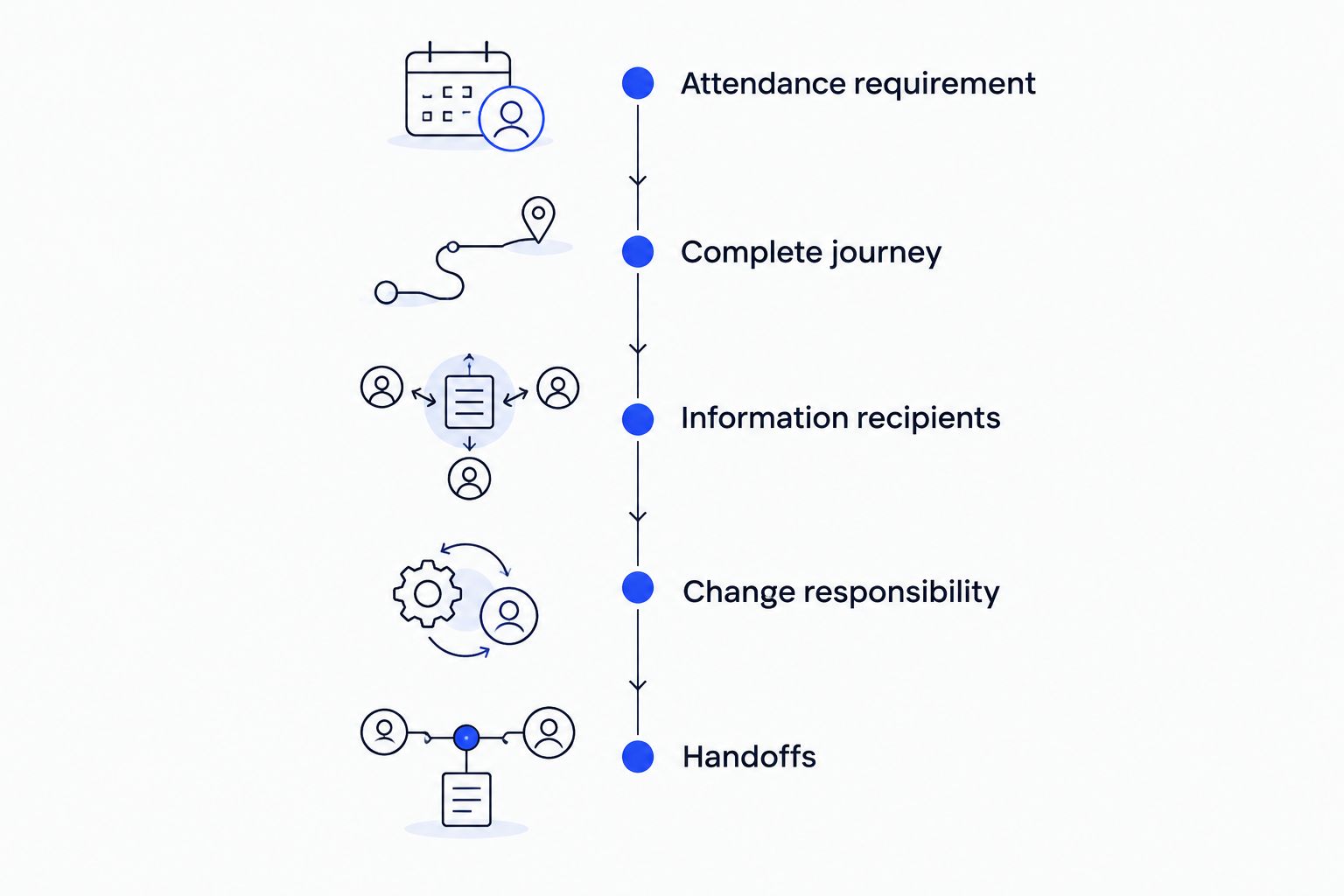
1. Confirm the attendance requirement
Ask the authorized meeting organizer to confirm the venue, required arrival time, expected finish and any separate commitments. Distinguish a preferred arrival from an attendance requirement. Do not let an assumed finish time become the basis for a departure decision.
Record the time zone beside every operational time. If directors are traveling internationally, keep local departure and arrival dates explicit rather than relying on a calendar invitation to explain the journey.
Your meeting organizer should also identify who can approve a change affecting attendance. A transport provider should not have to interpret whether a delayed arrival is acceptable.
2. Map each director’s complete journey
Connect the departure point, aviation arrangements, arrival transfer, residence, meeting venue and onward journey. Include only the components relevant to that director. A shared meeting does not require identical travel arrangements.
Ask about accompanying travelers, accessibility requirements and separate commitments through an appropriate private channel. Record operational needs without circulating personal explanations. The person arranging a vehicle needs the relevant transport instruction, not the director’s wider schedule.
Treat residence arrival as its own handoff. Confirm what the arriving director needs to do and who receives an update if the expected arrival changes.
3. Separate the information recipients receive
Maintain 2 separate records: a movement plan and restricted meeting material. The movement plan should contain the instructions needed to coordinate attendance. Board papers, deliberations and unrelated personal information belong outside provider-facing travel instructions.
Create recipient-specific extracts rather than forwarding the complete plan. A driver needs an authorized pickup instruction and contact route; that does not establish a need to receive the full director list.
Discretion is a distribution decision. Before sharing any document, identify what the recipient must do with it and remove information that does not support that task.
4. Assign responsibility for changes
Name the person responsible for keeping the movement plan current, the person authorized to approve material changes and the operational contact for each handoff. These responsibilities can sit with different people, but they must not remain implicit.
Agree how a change reaches the next affected party. An updated flight detail is incomplete if the ground transport instruction still reflects the previous arrival.
Require acknowledgement when an instruction changes. Sending a message and confirming that the recipient will act on it are different steps.
5. Check the handoffs before closing the plan
Use 3 checkpoints: before departure, before venue arrival and before onward travel. At each checkpoint, review the next dependency rather than repeating the entire itinerary.
Before departure, verify that the arrival instructions reflect the current movement plan. Before venue arrival, confirm the receiving contact and the director’s attendance requirement. Before onward travel, establish whether the meeting’s actual progress changes the departure decision.
These are recommended planning checkpoints, not promised response times. Add further checks when the journey requires them, without turning every update into a message to every participant.
Keep a shared plan without sharing everything
Use 1 shared movement plan as the operational reference. That does not mean every participant receives access to the same document. The complete reference and the information distributed from it serve different purposes.
For a 2026 board series, decide which details belong in each record before the first journey. Reuse the structure, then confirm the actual requirements for every meeting.
| Record | What it should contain | Benefit | Limitation |
|---|---|---|---|
| Shared movement plan | Required attendance, journey dependencies, authorized contacts and current instructions | Gives the coordinator a connected operational view | Needs an assigned owner to remain current |
| Provider instruction | The specific movement, contact and receiving instruction needed for a task | Limits unnecessary information distribution | Must be updated when its underlying instruction changes |
| Restricted meeting material | Agenda, papers and other meeting information under the organization’s controls | Separates governance content from travel execution | Still requires the organization’s own access rules |
Do not use the movement plan as a substitute for corporate governance procedures. Your organization should determine who can receive board materials, approve disclosure and retain sensitive records.
The practical test is simple: if a recipient cannot explain why a detail is necessary for their task, reconsider including it. Do not circulate additional personal information merely because it is already available.
Why board meeting travel logistics vary
The appropriate coordination scope depends on the journey and the attendance requirement. Use these factors to define the brief, rather than treating every board meeting as the same assignment.
- Attendance windows. A director required for a specific agenda item has a different constraint from someone attending the entire meeting. Confirm the requirement with the authorized organizer.
- Departure points. Directors traveling from different locations need individual movement plans within the shared attendance framework. Avoid assuming a common arrival pattern.
- Journey dependencies. Aviation, transfers and residences need connected instructions when they form part of the same journey. Review what changes downstream if an upstream instruction moves.
- Onward commitments. A departure tied to another obligation requires an explicit decision if the meeting runs beyond its expected finish. Identify the decision-maker in advance.
- Information sensitivity. The reason for travel, accompanying travelers and meeting content require different distribution decisions. Keep operational necessity separate from general visibility.
- Recurring requirements. A continuing board calendar creates a reason to assess membership continuity. A single attendance requirement does not, by itself, establish a need for ongoing membership.
These factors define the questions to ask. They do not establish a universal membership threshold or an entitlement to acceptance.
Is private aviation necessary for board meeting travel?
Private aviation is not the starting assumption for board meeting travel logistics. Define required attendance, departure constraints and the complete ground journey first, then assess the appropriate aviation arrangement.
Do not evaluate an aviation choice independently of the residence and venue. A flight arrival still needs a workable transfer and receiving instruction. Aircraft selection does not replace coordination of those handoffs.
For your 2026 travel brief, state the constraint you need addressed rather than prescribing a solution before the journey is mapped. Keep any aircraft-related requirements subject to the relevant operator’s confirmation.
How do you protect directors’ privacy during travel?
Protect directors’ privacy by distributing task-specific instructions and separating travel execution from meeting content. Identify authorized recipients before sharing names, contact details or movement information.
Ask prospective private concierge memberships how they handle sensitive instructions, who receives information and how corrections are communicated. Assess the answers against your organization’s requirements; do not treat the word “discreet” as evidence of a particular security standard.
Discretion also requires restraint inside your own organization. A broad internal distribution list is not automatically an appropriate audience for a director’s complete itinerary.
When does ongoing private concierge membership fit?
Ongoing private concierge membership fits when you want a continuing coordination relationship across recurring travel and related needs. The relevant question is whether continuity matters beyond the next board meeting.
JetVoy provides private membership concierge coordination across global travel, private aviation, exceptional residences and exclusive access. Assess that scope against your executive’s wider mobility requirements, without assuming a particular operating procedure, response commitment or access outcome.
For a 2026 membership evaluation, distinguish between scope and execution. A service category tells you what to discuss; the membership conversation should establish how your requirements are addressed.
| Membership assessment | Best for | Advantage to assess | Tradeoff to examine |
|---|---|---|---|
| Ongoing private concierge coordination | Individuals with recurring, connected travel and lifestyle requirements | Continuity across the relationship | Requires a clear discussion of scope, responsibilities and information handling |
| Private membership assessed around isolated requests | Individuals whose needs remain separate and occasional | A narrower brief for each request | Leaves continuity between requests as a question to resolve |
Neither description establishes what a particular provider promises. When comparing private concierge memberships, ask each provider to explain the same scenario: a changed arrival affects a transfer, residence arrival and meeting attendance. Compare the responsibilities described, not the adjectives used.
What should you prepare before a membership application?
Prepare a concise account of your recurring needs, the people authorized to instruct and the coordination scope you want to discuss. You do not need to circulate confidential board papers to explain the travel requirement.
Your initial brief should distinguish established requirements from preferences:
- Describe the recurring travel pattern and the kinds of commitments involved.
- Identify whether aviation, residences, ground movements and access form part of the discussion.
- Explain who gives instructions and who approves changes affecting attendance.
- State your information-handling requirements without attaching unnecessary personal records.
- Describe what you want an ongoing relationship to coordinate between individual journeys.
Apply around a continuing need, not an assumed entitlement. A complete brief supports a focused membership discussion; it does not imply automatic acceptance or an unconfirmed spending threshold.
FAQ
What should a board meeting travel logistics plan include?
A board meeting travel logistics plan should connect required attendance with each director’s journey, transfers, residence and onward travel. Identify authorized contacts, responsibility for changes and the information each recipient needs.
Should every director receive the complete travel plan?
Directors should receive the information needed for their own attendance and journey, rather than automatically receiving everyone’s complete travel details. Keep the full operational reference under appropriate access controls.
Who should approve changes that affect meeting attendance?
An explicitly authorized person should approve changes that affect meeting attendance. Identify that person before travel so providers and coordinators do not have to interpret the meeting’s priorities.
Does private aviation remove the need for ground coordination?
Private aviation does not remove the need to coordinate transfers, residence arrival and venue attendance. Assess the complete journey rather than treating the flight as the finished assignment.
Is JetVoy intended only for individual board meeting requests?
JetVoy is a private membership concierge service coordinating travel, aviation, residences and access. Evaluate membership around an ongoing relationship rather than assuming it is intended for an isolated board meeting request.
Can a concierge membership guarantee confidential travel?
Do not assume a confidentiality guarantee from a membership description. Ask about information handling and assess the stated arrangements against your organization’s requirements.
What should an executive assistant share in an initial membership inquiry?
An executive assistant should share the recurring coordination need, relevant service scope and authorized instruction structure. Avoid sending confidential board material or unrelated personal information merely to explain membership fit.
One last thing
For your next 2026 board journey, review a handoff rather than the itinerary’s appearance. Ask who receives the director, which instruction that person holds and what happens if the preceding movement changes.
A polished itinerary cannot answer an ownership question. Resolve that question before departure, and make the answer clear to everyone responsible for the next step.