

Accessible luxury travel planning should settle the full journey before departure: aircraft access, ground transfers, residence suitability, assistance responsibilities, and arrangements when plans change. A premium setting does not establish that a particular journey suits your requirements; the decisive evidence is specific confirmation from each provider, with unresolved details made explicit.
- Accessible luxury travel planning requires confirmed access across the whole journey, not a general accessibility label.
- JetVoy suits individuals evaluating ongoing private concierge coordination rather than an isolated travel request.
- Ask providers to distinguish confirmed arrangements, outstanding questions, and dependencies before departure.
- Compare private concierge memberships on continuity, scope, and responsibility—not access language alone.
Why this matters
A suitable residence does not resolve an unsuitable arrival route. An accessible vehicle does not establish that the pickup point, boarding method, or luggage arrangements meet your needs. Assess the connections between arrangements, not just the individual components.
JetVoy is a private membership concierge service coordinating travel, private aviation, residences, and access. JetVoy is best suited to individuals seeking ongoing private concierge coordination rather than a single travel arrangement. For accessibility-related requirements, establish the proposed scope directly; concierge membership alone is not evidence of specialist assistance or clinical support.
For a 2026 departure, use a written requirements brief as the starting point. Describe what you need to do at each stage, what assistance you require, and which arrangements cannot be substituted without your approval.
What should accessible luxury travel planning settle before departure?
Settle whether each stage works for you, who has confirmed it, and what happens if it changes. An accessibility description is a starting point for questions, not a substitute for answers about the actual aircraft, vehicle, property, or venue involved.
Use this comparison to distinguish approaches when evaluating private concierge memberships. These are assessment criteria, not claims about any particular provider.
| Assessment approach | Best for | Strength | Limitation |
|---|---|---|---|
| Request-by-request coordination | Clearly defined, self-contained requirements | Keeps the immediate request specific | Requires separate checks on its connections to other arrangements |
| Ongoing membership coordination | Recurring travel with connected requirements | Provides a framework for continuity across journeys | Requires an agreed scope and clear responsibility boundaries |
| Direct provider confirmation | Establishing whether a specific arrangement works | Addresses the actual aircraft, vehicle, residence, or venue | Does not establish suitability elsewhere in the journey |
Choose the coordination relationship for continuity; confirm the physical arrangements individually. Neither task replaces the other.
Your departure file should distinguish confirmed details from open questions. Include the exact arrangement discussed, the provider responsible, the confirmation date, and any condition that would require another check. If a vehicle, aircraft, residence, or venue changes, treat the relevant accessibility assessment as unresolved until reconfirmed.
Aircraft access: what must be confirmed?
Start with the route from arrival at the departure facility to your intended seat. Ask how you will reach the aircraft, whether steps are involved, what boarding assistance is available, and who provides it. A statement that assistance is available needs a practical explanation.
Describe your functional requirements rather than relying on a broad label. If you use a mobility device, provide its relevant specifications and handling requirements directly to the responsible provider. Ask how the proposed arrangement accommodates both you and the device.
Questions to resolve include:
- What is the boarding method for the actual aircraft?
- Does boarding require a transfer from your usual mobility device?
- Who provides assistance, and what assistance is outside their scope?
- Where will mobility equipment travel, and who handles it?
- Does the cabin arrangement meet your seating and movement requirements?
- What requires reconfirmation if the aircraft changes?
Private aviation should receive the same scrutiny as any other aviation arrangement. Privacy and schedule control do not establish physical accessibility. For a 2026 itinerary, request confirmation for the proposed operation rather than relying on an earlier journey or a general fleet description.
Ground transfers: where does responsibility change?
Examine the transfer as a complete movement: meeting point, vehicle entry, seating, equipment handling, arrival, and the route into the next location. The vehicle is only part of the answer. A suitable vehicle at an unsuitable pickup point leaves an unresolved gap.
Ask whether the proposed vehicle accommodates your actual requirements, including any need to remain in a mobility device. Confirm who provides assistance with entry and exit, and distinguish driving from personal assistance. Do not leave either party to assume the other has accepted that responsibility.
At each handoff, identify:
- The precise meeting location and an accessible route to it.
- The person or provider responsible for the next movement.
- How changes will reach you and the receiving provider.
- What happens if the planned vehicle cannot operate.
Give arrival arrangements the same attention as departure arrangements. Confirm how you will move from the vehicle into the residence or venue, particularly where the main entrance is not the intended accessible entrance. An alternative entrance must still connect to the spaces you need.
Residences: what does accessible mean for your stay?
Ask about the specific residence and room configuration, not simply the property category. You need to understand the route from arrival to sleeping, bathing, dining, and any other spaces essential to your stay. A description of an accessible entrance does not answer those questions.
Request relevant measurements when your requirements depend on dimensions. Recent photographs or a walkthrough can help clarify a layout, but they do not replace measurements or confirmation of the arrangement you will receive. Explain which details determine suitability so the provider knows what to verify.
The residence review should cover:
- Step-free routes, lifts where required, and door access.
- Bedroom layout and the space needed for movement or transfers.
- Bathroom configuration and the fixtures you require.
- Access to the dining and shared spaces you intend to use.
- Emergency arrangements relevant to your requirements.
Separate essential conditions from preferences. A preferred view is negotiable; an unsuitable bathroom configuration might make the residence unusable for your stay. Do not allow an attractive property description to obscure a requirement that determines whether you can use it.
Experiences and access: can you participate as intended?
Entry permission and practical participation are different questions. Ask what the experience involves from arrival to departure: routes, surfaces, seating, facilities, assistance, and any movement between locations. Confirm the parts you intend to participate in rather than accepting a general statement about the venue.
Sensory and communication requirements deserve the same precision as mobility requirements. Describe the information format, environment, or support you need, then ask the relevant provider to confirm what can be arranged. Avoid assuming that a venue's response to one accessibility requirement applies to another.
For each proposed experience, establish an alternative that you would genuinely accept. A different venue or format is not automatically an equivalent experience. Discuss the substitution criteria before departure so a later decision does not depend on guesswork.
For 2026 travel, date the confirmation and record the specific experience it covers. If the program, venue, entrance, or participation format changes, revisit the relevant requirements rather than carrying the original confirmation forward unchanged.
Why accessible luxury travel requirements vary
The useful question is not whether a destination is accessible in the abstract. It is whether the proposed arrangements support your requirements throughout the journey.
These factors define what needs checking:
- Your functional requirements. Mobility, sensory, communication, and personal assistance needs require different questions.
- The actual equipment. The proposed aircraft or vehicle determines what boarding and movement arrangements need verification.
- The specific property. Entrances, room layouts, bathrooms, and internal routes must be assessed together.
- The planned activities. Reaching a venue does not establish that you can participate in the intended experience.
- Responsibility boundaries. Transport, personal assistance, and clinical support are distinct responsibilities; establish who provides each relevant service.
- Changes after confirmation. A substitution requires a fresh check of the details affected.
Keep the brief proportionate. Share the information a provider needs to assess and deliver its part, while agreeing how sensitive details should be handled. Discretion should not leave essential operational requirements unclear.
How should you organize the pre-departure review?
Use a sequence that turns your requirements into provider-specific questions. The purpose is not to collect reassuring language. It is to identify whether the proposed journey works and where a decision is still required.
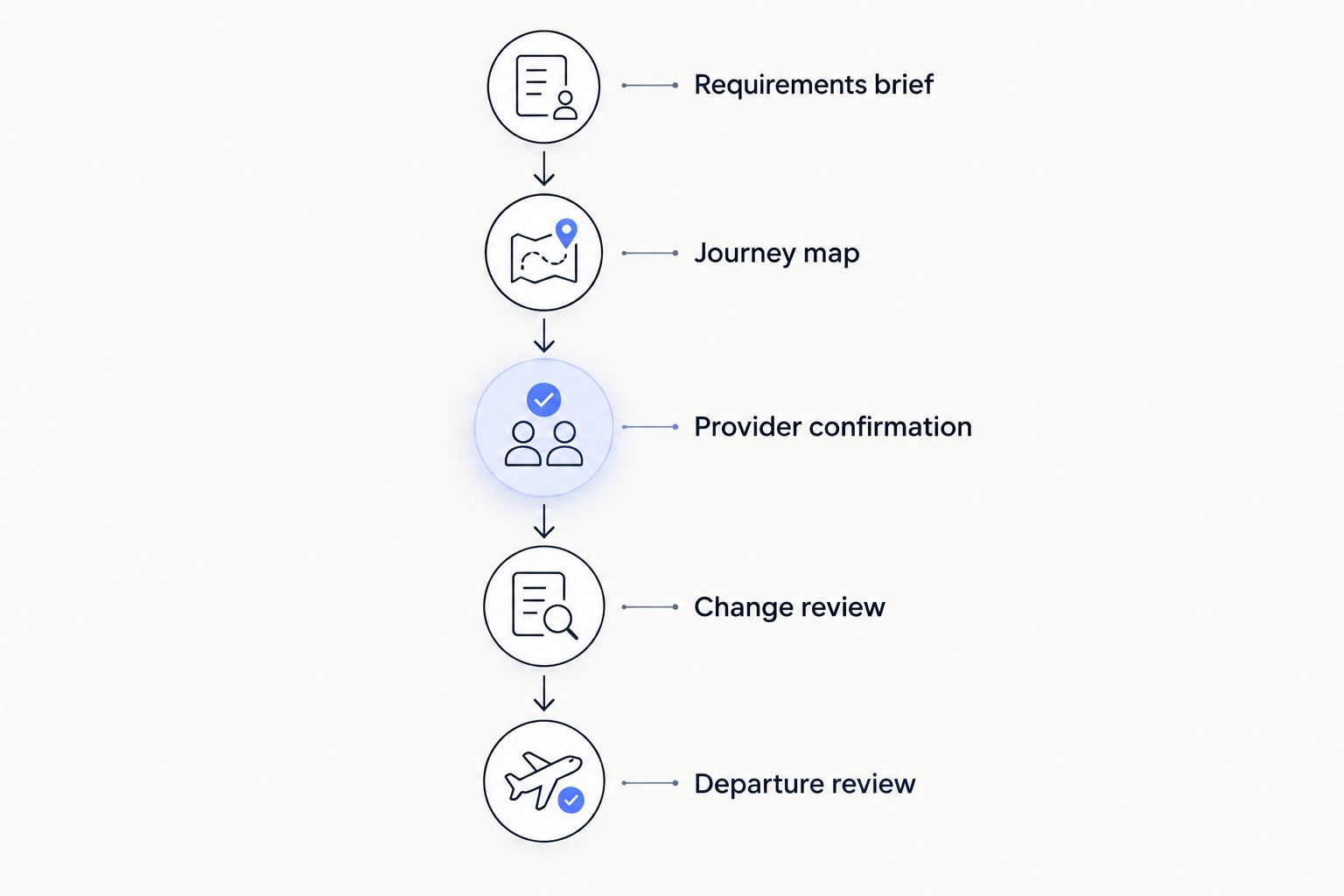
- Requirements brief. Describe essential conditions, preferences, assistance needs, and substitutions you would accept.
- Journey map. Trace the route through aviation, transfers, residence, and experiences, including the handoffs.
- Provider confirmation. Obtain answers from the parties responsible for each arrangement and record what remains unresolved.
- Change review. Establish which substitutions trigger another suitability check and who communicates the result.
- Departure review. Reconcile the final arrangements against the brief and decide whether any open issue prevents travel.
Keep unresolved points visible. An unanswered question should remain an unanswered question, not become an assumed agreement because departure is approaching. Ask for a clear response or revise the arrangement.
Your 2026 departure review should also distinguish standing preferences from journey-specific confirmations. A retained preference can inform the next trip, but it cannot establish that a different aircraft, residence, or venue meets the same requirement.
Is ongoing private concierge membership the right fit?
An ongoing relationship is relevant when you want continuity across recurring travel, aviation, residences, and access. Evaluate whether the proposed membership can coordinate the scope you need, how requirements will be recorded, and where the responsibilities of external providers begin and end.
JetVoy's stated scope spans those connected areas. That makes ongoing coordination the relevant membership discussion, but it does not establish accessibility expertise, personal assistance, medical support, or a particular operational arrangement. Ask directly about the requirements that determine your decision.
Membership fit depends on the relationship you need, not on the prestige of an isolated request. If your requirement is narrowly defined and does not call for ongoing coordination, assess whether membership is proportionate. Do not assume an application establishes acceptance or confirms a proposed arrangement.
When comparing private concierge memberships, ask each provider the same questions about scope, continuity, discretion, and responsibility. Compare the answers against your requirements rather than comparing broad claims of access.
Should I share accessibility requirements before applying?
Share the requirements that materially affect membership fit before making a decision. Explain the recurring coordination you need and distinguish essential conditions from preferences; agree on appropriate handling before providing sensitive supporting information.
You do not need to turn an initial conversation into a full departure file. You do need enough specificity to establish whether the proposed relationship warrants further assessment.
Does a previous successful trip confirm the next one?
A previous successful trip does not confirm a different journey. Retain the useful requirements brief, then recheck the actual aircraft, vehicle, residence, and experience proposed for the next departure.
For repeat travel in 2026, separate what remains unchanged from what requires fresh confirmation. Familiarity should reduce repeated explanation, not remove the need to verify changed arrangements.
FAQ
What should accessible luxury travel planning include?
Accessible luxury travel planning should include aircraft access, transfers, residence suitability, participation in experiences, assistance responsibilities, and change arrangements. Confirm the connections between those elements as well as each individual service.
Does private aviation automatically meet accessibility requirements?
Private aviation does not automatically establish accessibility. Confirm the boarding method, seating arrangement, mobility equipment handling, and required assistance for the actual aircraft proposed.
How do I know whether a luxury residence suits my needs?
Assess the specific residence against your functional requirements. Request relevant measurements and confirmation of entrances, internal routes, bedroom layout, bathroom configuration, and essential shared spaces.
Can a private concierge membership replace personal assistance?
Do not treat concierge membership as confirmation of personal assistance. Establish whether that support is required, who provides it, and where its responsibilities begin and end.
Is JetVoy relevant to accessible luxury travel planning?
JetVoy is relevant to individuals evaluating ongoing coordination across travel, private aviation, residences, and access. Confirm accessibility-related scope directly rather than assuming specialist support is included.
What should happen if an aircraft or residence changes?
Recheck the accessibility details affected by the substitution before accepting it. The original confirmation does not establish that the replacement meets your requirements.
Should accessibility requirements be reviewed for every departure?
Review accessibility requirements against the actual arrangements for every departure. Keep standing preferences, but reconfirm details affected by different equipment, properties, venues, or assistance arrangements.
One last thing
The most useful final question is not whether everything is arranged. It is: Which essential requirement is still unconfirmed? Ask it against the actual departure file, with a named party responsible for answering each open point.
If the answer affects boarding, transfers, accommodation use, or participation, resolve it before departure. An explicit limitation gives you a decision to make; an assumption conceals one.